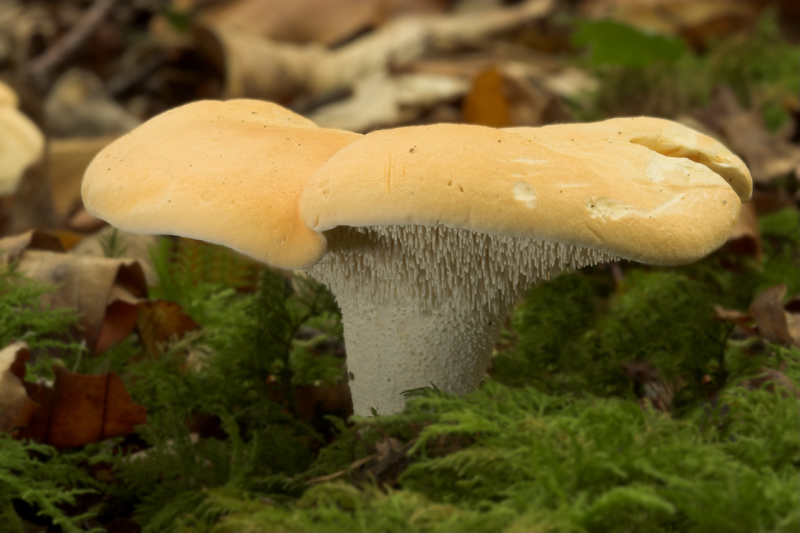
Wood Hedgehog
Hydnum repandum
Photo: Wikimedia Commons (CC) via https://en.wikipedia.org/wiki/Hydnum_repandum
Overview
Wood Hedgehog (Hydnum repandum)
The Wood Hedgehog is a distinctive edible mushroom characterized by its cream to pale orange cap and unique spore-bearing surface covered in small, downward-pointing spines rather than gills or pores. These fungi typically measure 5-15 cm across with thick, often off-center stems. As mycorrhizal organisms, they form essential symbiotic relationships with tree roots, facilitating nutrient exchange and supporting forest health while decomposing organic matter.
This species demonstrates remarkable global distribution, occurring across temperate and boreal forests in Europe, North America, and Asia, with additional populations in Australia, New Zealand, and parts of South America. Wood Hedgehogs favor deciduous and mixed woodlands, particularly associating with beech, oak, and coniferous trees, thriving in well-drained soils with adequate moisture.
Despite its widespread range, the Wood Hedgehog faces mounting pressures from habitat fragmentation and forest degradation. Intensive forestry practices, urbanization, and climate-induced changes to forest composition threaten the stable woodland ecosystems this species requires. The fungus's dependence on mature forest networks makes it particularly vulnerable to logging and land conversion.
Conservation efforts remain limited, with most protection occurring indirectly through forest preservation initiatives and sustainable forestry practices in various countries. Some European nations include the species in biodiversity monitoring programs, though comprehensive assessment data remains sparse.
The current outlook reflects uncertainty due to insufficient population monitoring across its range. While the species maintains presence in numerous countries, the unknown population trend and vulnerable status suggest potential decline, particularly in regions experiencing significant forest loss or management intensification.
Habitat fragmentation and intensive forestry practices threaten Wood Hedgehog populations by disrupting the mature forest ecosystems and mycorrhizal networks essential for their survival. Climate change and soil degradation further compound these pressures, affecting the delicate balance between the fungus and its host trees.
Habitat
Collection from Eggingen, Germany
H. repandum is a mycorrhizal fungus. They can also grow in fairy rings.
Other threatened species in Hydnaceae


Threatened in Åland Islands


Frequently asked questions
Why is Wood Hedgehog classified as Vulnerable?
Where does Wood Hedgehog live?
What are the main threats to Wood Hedgehog?
Get weekly conservation intelligence
One short digest a week of the most striking species and country data we ship, plus breaking conservation news paired with our database where it matters.
Free, no spam. One-click unsubscribe in every email.