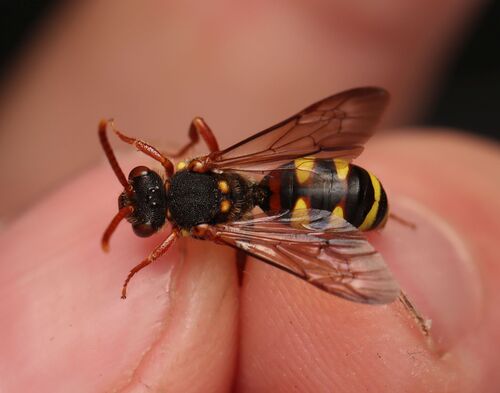
Bourdon inattendu
Bombus inexspectatus
Bourdon inattendu (Bombus inexspectatus) is a robust bumblebee species characterized by its distinctive black and yellow striped pattern with notably bright orange-red patches on its thorax. As a critical pollinator, this species plays an essential role in maintaining plant diversity and ecosystem stability in its native range, with worker bees forming colonies of 50-200 individuals that forage across extensive territories.
4
Countries
Taxonomy & Classification
Kingdom
Animalia
Phylum
Arthropoda
Class
Insecta
Order
Hymenoptera
Family
Apidae
Genus
Bombus
Bourdon inattendu belongs to the family Apidae, order Hymenoptera, within the Insecta class.
Species Profile
Bourdon inattendu (Bombus inexspectatus) is a robust bumblebee species characterized by its distinctive black and yellow striped pattern with notably bright orange-red patches on its thorax. As a critical pollinator, this species plays an essential role in maintaining plant diversity and ecosystem stability in its native range, with worker bees forming colonies of 50-200 individuals that forage across extensive territories.
Bombus inexspectatus faces severe population declines primarily due to habitat loss from agricultural intensification and urban development across its limited range. Climate change is altering the timing of flowering plants that this species depends on for nectar, creating mismatches between bee emergence and food availability.
Key Facts
Habitat & Distribution
This bumblebee inhabits montane meadows and alpine grasslands between 1,200-2,800 meters elevation, where it depends on diverse wildflower communities including native clovers, lupines, and alpine asters. The species requires undisturbed areas with suitable underground nesting sites in well-drained soils near forest edges or rocky outcrops.
Threats
IUCN Red List: Endangered
Bombus inexspectatus faces severe population declines primarily due to habitat loss from agricultural intensification and urban development across its limited range. Climate change is altering the timing of flowering plants that this species depends on for nectar, creating mismatches between bee emergence and food availability.
Agricultural intensification and pesticide use
Climate change affecting plant-pollinator synchrony
Habitat fragmentation and loss
Invasive plant species altering native plant communities
Urban and infrastructure development
Found in 4 Countries
National vs Global Threat Status
How this species is assessed at the national level compared to its IUCN global status (EN).
| Country | National Status | Global Status | Comparison |
|---|---|---|---|
| EU | ENEndangered | ENEndangered | Same |
National Red List data sourced from the National Red List Project (nationalredlist.org, ZSL) and country-specific Red List authorities.
Community Sightings
Report a sightingNo community sightings yet. Be the first to report!
Sources & Attribution
How to Cite
IUCN: IUCN (2025). The IUCN Red List of Threatened Species. Version 2025-1. Available at: https://www.iucnredlist.org. doi:10.2305/IUCN.UK.2025-1.RLTS
GBIF: GBIF.org (2025). GBIF Home Page. Available at: https://www.gbif.org
National Red Lists: ZSL (2025). National Red List. Zoological Society of London. Available at: https://www.nationalredlist.org
This page: SpeciesRadar (2025). Bourdon inattendu (Bombus inexspectatus). SpeciesRadar: Intelligence for Earth's Biodiversity. Available at: https://speciesradar.org/species/bourdon-inattendu