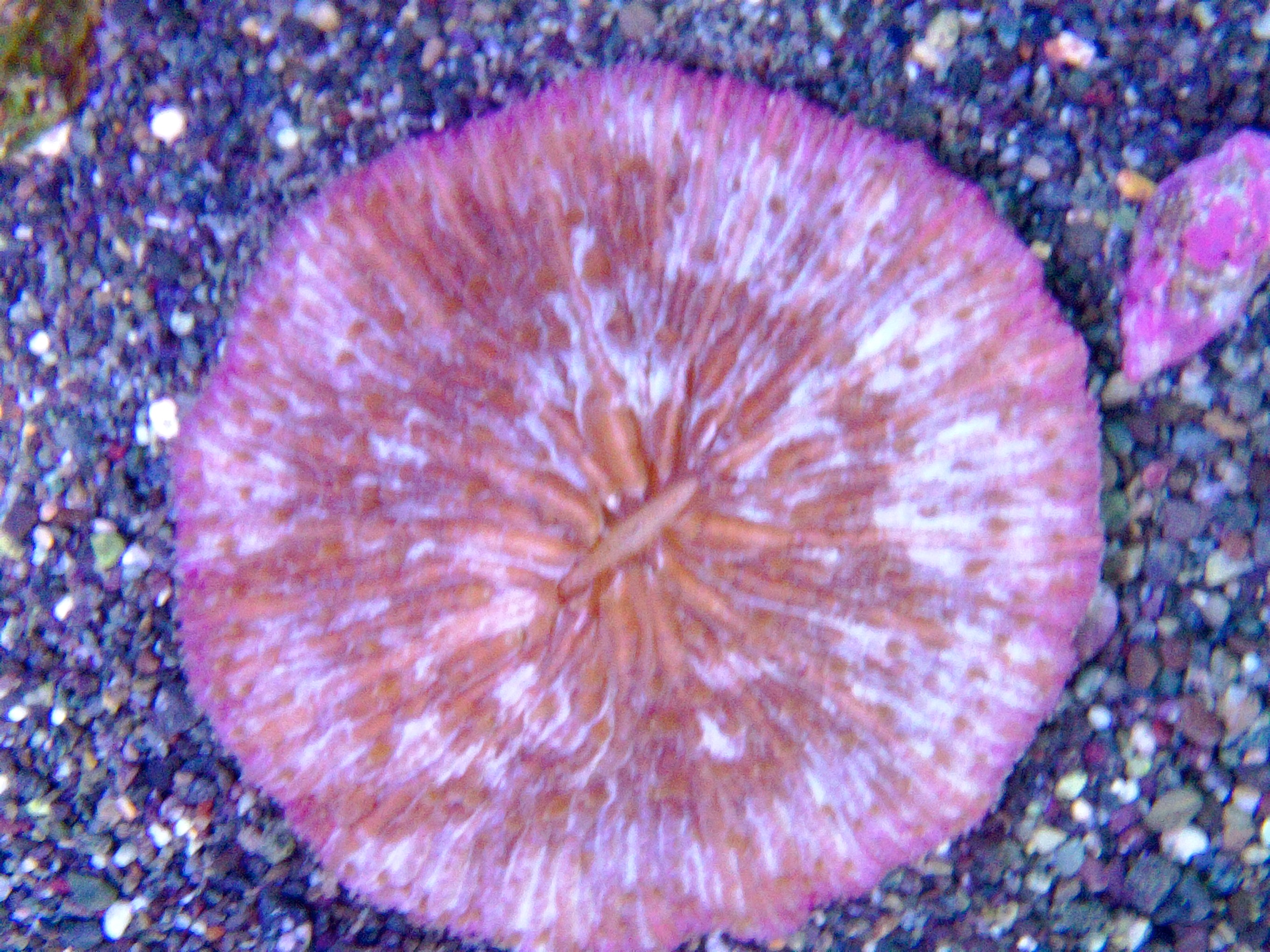
Elongate Mushroom Coral
Pleuractis paumotensis
Photo: Wikimedia Commons (CC) via https://en.wikipedia.org/wiki/Pleuractis_paumotensis
Overview
Pleuractis paumotensis is a solitary stony coral belonging to the family Fungiidae, the mushroom corals. Unlike reef-building species that form permanent colonial structures, fungiid corals such as this one are typically free-living as adults, with an elongated, oval-shaped skeleton bearing radiating septa that give it a mushroom-like appearance. Many species in this genus are capable of limited movement across the substrate and can right themselves if overturned, an adaptation that helps them avoid sediment burial.
As with other scleractinian corals, it hosts symbiotic zooxanthellae that supply energy through photosynthesis, while the coral itself contributes to the structural and biological complexity of the reef habitats it occupies.
This species inhabits shallow marine neritic waters and has been recorded in the United States, New Caledonia, Madagascar, Australia, China, and Japan, reflecting a broad but patchy distribution across the Indo-Pacific region.
The species faces a wide array of pressures. Coastal mining and quarrying degrade reef substrate, while fishing and harvesting activities, including collection for the aquarium trade, remove individuals directly from populations. Recreational activities and pollution from domestic wastewater and agricultural runoff reduce water quality, and sediment from land-based agricultural expansion smothers coral tissue.
Invasive species, disease, and broader habitat shifts linked to changing ocean conditions compound these stressors.
Conservation measures include protections within existing marine protected areas across parts of its range, along with international trade regulation for fungiid corals. No numerical population estimates are available.
Given the breadth and persistence of ongoing threats and its listed decreasing population trend, the species' outlook remains concerning, with continued habitat degradation likely without stronger local management and water quality controls.
The Elongate Mushroom Coral faces damage from coastal quarrying and mining, being caught or disturbed during fishing and harvesting activities, and disturbance from recreational activities like diving and boating. It's also affected by pollution from sewage, agricultural runoff, and farming activities, as well as competition from invasive species and disease, and broader changes to its reef habitat from environmental shifts. All of these threats are currently ongoing and show no signs of slowing down.
Habitat
Conservation measures underway
Other threatened species in FUNGIIDAE

Threatened in Australia
Frequently asked questions
Why is Elongate Mushroom Coral classified as Endangered?
Where does Elongate Mushroom Coral live?
What are the main threats to Elongate Mushroom Coral?
Get weekly conservation intelligence
One short digest a week of the most striking species and country data we ship, plus breaking conservation news paired with our database where it matters.
Free, no spam. One-click unsubscribe in every email.