
Brain Root Coral
Lobophyllia corymbosa
Photo: Wikimedia Commons (CC) via https://en.wikipedia.org/wiki/Lobophyllia_corymbosa
Overview
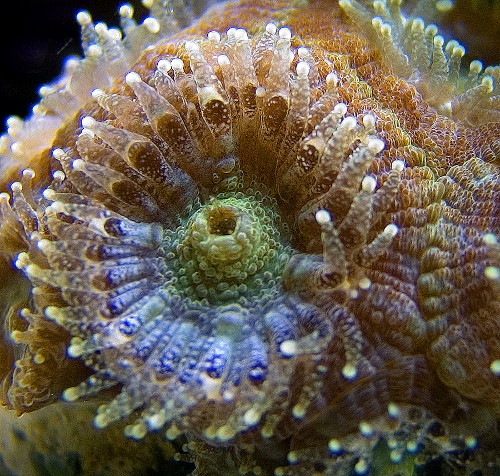
Lobophyllia corymbosa is a large polyp stony coral belonging to the family Lobophylliidae, recognizable by its fleshy, meandering skeletal ridges and vividly colored oral discs, often in shades of green, brown, or red. Its colonies form flabello-meandroid or valley-like structures, giving it the common association with brain-like patterns despite its distinct genus. Like other scleractinian corals, it hosts symbiotic zooxanthellae that provide energy through photosynthesis, while its polyps extend at night to capture plankton with specialized tentacles.
As a reef-building species, it contributes structural complexity to reef ecosystems, providing shelter and habitat for numerous marine organisms.
This species occupies marine neritic zones across a broad Indo-Pacific range, including reef systems in Australia, Japan, China, Taiwan, Vietnam, Madagascar, and the Marshall Islands. It typically inhabits shallow reef slopes and lagoons where light penetration supports its symbiotic algae.
Population decline is driven by a combination of pressures. Mining and quarrying activities degrade nearby reef substrate, while fishing and harvesting practices cause direct physical damage. Recreational activities, including diving and anchoring, add further stress.
Water quality is compromised by agricultural effluents, domestic wastewater, and other pollution sources, promoting algal overgrowth and disease. Invasive species and native pathogens increase mortality, while broader habitat shifting—linked to warming seas and acidification—affects reef stability and coral health.
Conservation measures include marine protected areas within parts of its range, coral reef monitoring programs, and international trade regulation under CITES. Restoration efforts, including coral gardening and transplantation, are underway in several Indo-Pacific nations.
Given the persistence of multiple concurrent stressors and continued habitat degradation, the population trend remains decreasing, and the species' long-term outlook remains uncertain without substantial reduction in cumulative threats.
Brain Root Coral faces ongoing damage from coastal mining and quarrying activities, pollution from sewage and agricultural runoff, and physical disturbance from fishing, harvesting, and recreational activities like diving or boating. It's also threatened by climate-driven habitat changes, invasive species, disease, and expanding farmland near coastal areas. All of these pressures are currently ongoing and show no signs of easing, suggesting the threats remain steady to intensifying rather than decreasing.
Habitat
Conservation measures underway
Other threatened species in LOBOPHYLLIIDAE

Threatened in Australia
Frequently asked questions
Why is Brain Root Coral classified as Vulnerable?
Where does Brain Root Coral live?
What are the main threats to Brain Root Coral?
Get weekly conservation intelligence
One short digest a week of the most striking species and country data we ship, plus breaking conservation news paired with our database where it matters.
Free, no spam. One-click unsubscribe in every email.