Homophyllia australis
Overview
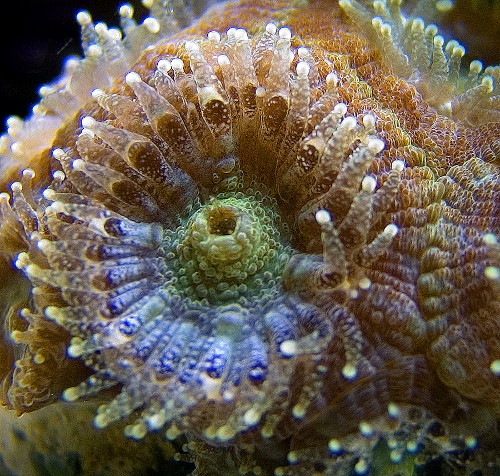
Homophyllia australis is a large-polyped stony coral in the family Lobophylliidae, prized for its fleshy, brightly colored mantle tissue that can obscure much of its calcareous skeleton. It is typically solitary or forms small colonies, favoring crevices and overhangs in rocky reef substrate. As with other scleractinian corals, it hosts symbiotic zooxanthellae, contributing to primary production on reefs and providing structural microhabitat for small invertebrates and fish.
The species occurs across the Indo-Pacific, with records spanning Australia, New Caledonia, Micronesia, the Marshall Islands, Malaysia, Vietnam, China, Japan, Iran, and Oman. It inhabits marine neritic waters and rocky reef areas, generally in shallow, sheltered zones.
The IUCN lists Homophyllia australis as Vulnerable, with a decreasing population trend. Its large, colorful polyps make it a target for the marine aquarium trade, where collection for fishing and harvesting of aquatic resources is a direct pressure. Coastal mining and quarrying degrade adjacent habitat and increase sedimentation.
Agricultural runoff, domestic wastewater, and other pollution sources reduce water quality, while recreational activities cause physical damage to colonies. The species is also vulnerable to invasive species, disease, and competition from problematic native species, compounded by broader habitat shifting linked to changing ocean conditions.
Conservation measures include its listing under international trade regulations affecting the aquarium trade, alongside marine protected areas within parts of its range that restrict harvesting and coastal development. Enforcement and monitoring capacity vary considerably between countries.
Given the combination of targeted collection, cumulative pollution, and habitat degradation across a wide but fragmented range, the species' population trajectory remains negative, and its long-term status will depend on stronger regulation of harvest and improved coastal water quality management.
Homophyllia australis, a type of coral, faces ongoing pressure from being collected for the aquarium trade and disturbed by coastal mining, quarrying, and recreational activities like diving and boating. It's also harmed by polluted runoff from farms, cities, and wastewater systems, as well as competition from invasive species and disease, and broader changes to its reef habitat from shifting environmental conditions. These combined pressures appear to be ongoing and persistent rather than easing, suggesting a stable but continuing level of threat.
Habitat
Conservation measures underway
Other threatened species in LOBOPHYLLIIDAE

Threatened in Australia
Frequently asked questions
Why is Homophyllia australis classified as Vulnerable?
Where does Homophyllia australis live?
What are the main threats to Homophyllia australis?
Get weekly conservation intelligence
One short digest a week of the most striking species and country data we ship, plus breaking conservation news paired with our database where it matters.
Free, no spam. One-click unsubscribe in every email.