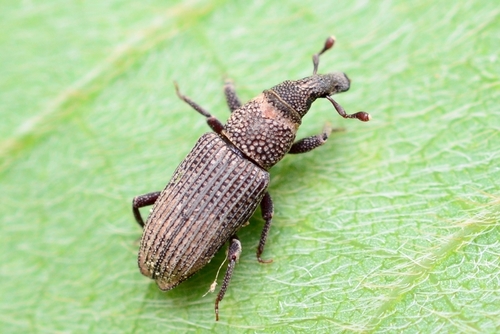
Wood-Boring Weevil
Dryophthorus corticalis
Photo: Photo: (c) WonGun Kim, all rights reserved, uploaded by WonGun Kim
Overview
Dryophthorus corticalis is a small, true weevil belonging to the family Dryophthoridae, distinguished by the elongated snout typical of the group and a compact, cylindrical body adapted for life within decaying wood. Both larvae and adults develop in and feed on well-decayed heartwood and dead wood in mature trees, particularly within old-growth or veteran hardwood stands. As a saproxylic insect, it contributes to the breakdown of dead wood and nutrient cycling within forest ecosystems, and its presence is often used as an indicator of ecological continuity in ancient woodlands.
The species has a wide but fragmented distribution across Europe, with records spanning countries including France, Germany, Poland, the United Kingdom, Russia, and much of Scandinavia and Central and Eastern Europe, as well as an isolated occurrence noted in Australia. It is restricted to specific microhabitats—hollow trunks, decaying heartwood, and deadwood cavities—found almost exclusively in old-growth forest remnants or long-undisturbed woodland.
No formal threat assessment or habitat classification has yet been completed for this species, and detailed population data are unavailable, leaving its population trend unknown. Its dependence on veteran trees and deadwood habitat, however, implies vulnerability to historical and ongoing loss of old-growth forest, intensive forestry practices, and removal of dead or dying trees, which limit the availability of suitable breeding substrate.
No species-specific conservation programs have been documented, though general woodland protection measures and deadwood retention policies in parts of its range may incidentally benefit it. Its Critically Endangered classification reflects extreme rarity and habitat specificity rather than confirmed population decline. Without targeted survey work, assessment of threats, and habitat protection measures, its long-term status remains highly uncertain.
The threats to this species have not yet been formally assessed, so no specific information is currently available about what risks it may face. Without this data, it's not possible to identify particular pressures such as habitat changes or other environmental factors affecting this species. As no assessment has been conducted, it is not possible to determine whether threats are intensifying, stable, or decreasing.
Habitat
This species inhabits mature forest ecosystems where it specializes in boring into dead and decaying hardwood trees. The weevil requires forests with sufficient dead wood and fallen trees to provide suitable microhabitats for feeding and reproduction.
Threatened in Australia
Frequently asked questions
Why is Wood-Boring Weevil classified as Critically Endangered?
Where does Wood-Boring Weevil live?
What are the main threats to Wood-Boring Weevil?
Get weekly conservation intelligence
One short digest a week of the most striking species and country data we ship, plus breaking conservation news paired with our database where it matters.
Free, no spam. One-click unsubscribe in every email.