Uperoleia martini
Local name: Martin’s Toadlet
Overview
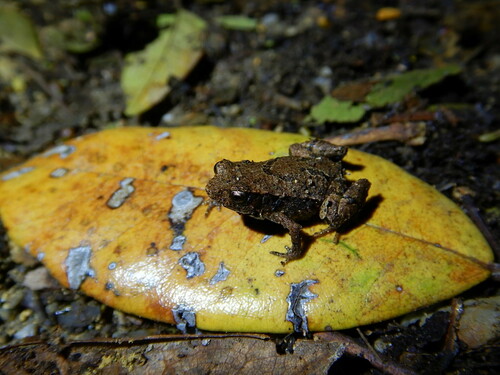
Uperoleia martini is a small ground-dwelling frog belonging to the family Myobatrachidae, a group of Australian and New Guinean burrowing and terrestrial frogs. Like other members of its genus, it is a compact, warty-skinned toadlet, typically active at night and reliant on temporary or permanent water bodies for breeding. Males call from concealed positions near water to attract mates, and the species likely feeds on small invertebrates such as ants and termites, contributing to pest regulation within its ecosystem while itself serving as prey for birds, reptiles, and other predators.
The species is endemic to Australia, where it occupies subtropical and tropical dry forests, wetlands including permanent freshwater lakes, and associated cave and subterranean habitats that may provide shelter during dry periods.
Population trends are declining, and the species is classified as Vulnerable. Habitat alteration from road and railroad construction fragments populations and disrupts breeding movements, while logging and land clearing for annual and perennial crops reduce available forest and wetland habitat. Drought conditions, likely intensifying with climate variability, threaten the temporary water sources needed for breeding.
Invasive species, including introduced predators and pathogens such as chytrid fungus common to Australian amphibians, add further pressure.
Conservation responses include habitat protection within existing reserves, ongoing monitoring of amphibian populations across its Australian range, and broader national efforts to manage invasive species and disease spread. Research into the species' distribution and ecological requirements remains important for guiding targeted conservation action.
Given continuing habitat loss, drought pressures, and disease threats, the species' population trajectory remains negative, and its long-term outlook depends on sustained habitat protection and effective disease and invasive species management.
Martin's Toadlet faces ongoing habitat destruction from road and railway construction, logging, and clearing land for crops, all of which shrink and fragment the places it lives. It also struggles with invasive species that may prey on it or compete with it, along with droughts and shifting environmental conditions that dry out or alter its breeding habitat. Since all these threats are currently listed as ongoing, the overall pressure on this species appears to be stable to intensifying rather than decreasing.
Habitat
Conservation measures underway
Other threatened species in MYOBATRACHIDAE

Threatened in Australia
Frequently asked questions
Why is Martin’s Toadlet classified as Vulnerable?
Where does Martin’s Toadlet live?
What are the main threats to Martin’s Toadlet?
Get weekly conservation intelligence
One short digest a week of the most striking species and country data we ship, plus breaking conservation news paired with our database where it matters.
Free, no spam. One-click unsubscribe in every email.