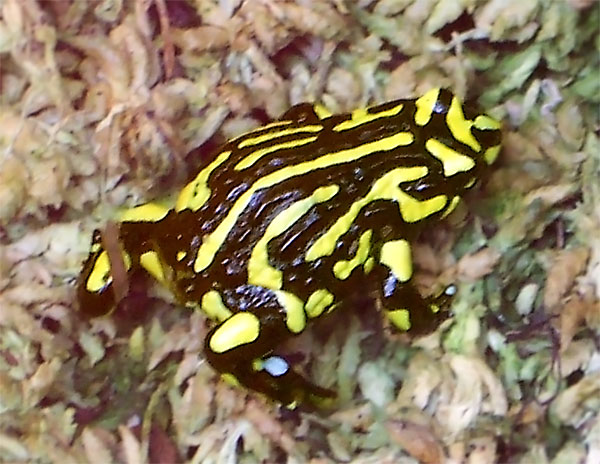
Corroboree Frog
Pseudophryne corroboree
Photo: Wikimedia Commons (CC) via https://en.wikipedia.org/wiki/Southern_corroboree_frog
Overview
The Corroboree Frog is a small terrestrial frog instantly recognizable by its striking black-and-yellow striped pattern—a warning coloration linked to toxic alkaloid secretions produced in its skin, which it derives independently rather than from dietary sources, unlike many other toxic amphibians. Adults typically measure 2.5–3 cm in length. Males call from burrows near sphagnum bogs and soaks during summer breeding periods, and females lay eggs in moist terrestrial nests, with larvae developing only after seasonal flooding washes them into adjacent ponds.
As both predator of small invertebrates and prey for other species, it contributes to nutrient cycling within its alpine and subalpine ecosystem.
This species is endemic to a narrow range in the Snowy Mountains of southern New South Wales, Australia, inhabiting montane forests, shrubland, and grassland, typically at high elevations associated with sphagnum bogs and wet heath.
Its decline stems from multiple compounding pressures: the amphibian chytrid fungus (a problematic pathogen) has driven severe population losses; altered fire regimes and fire suppression have degraded breeding habitat; climate-driven droughts and temperature extremes affect the moisture-dependent breeding sites; and habitat alteration from grazing and adjacent agricultural land use adds further strain.
Conservation efforts include captive breeding and reintroduction programs, disease research targeting chytrid resistance, habitat protection within Kosciuszko National Park, and monitoring of wild populations.
Wild populations remain critically low and continue to decline despite active intervention. Long-term survival is heavily dependent on continued captive breeding support and resolution of the chytrid fungus threat, without which natural recovery appears unlikely.
The Corroboree Frog faces a deadly combination of pressures: a introduced fungal disease (chytrid fungus) that infects and kills frogs, along with wildfires and the fire-management practices used to control them, both of which destroy the frog's mountain habitat. Climate-related problems—including droughts, extreme temperatures, and shifting weather patterns—are making its already-small alpine habitat less livable, while some agricultural land use adds further pressure. These threats are ongoing and show no signs of easing, meaning the situation remains serious and unresolved.
Habitat
This species inhabits high-altitude sphagnum bogs, wet heathlands, and adjacent woodlands in the Australian Alps, typically at elevations above 1000 meters. The frogs require these specialized bog ecosystems for breeding, where seasonal flooding of terrestrial nest sites triggers egg hatching.
Conservation measures underway
Other threatened species in MYOBATRACHIDAE


Threatened in Australia
Frequently asked questions
Why is Corroboree Frog classified as Critically Endangered?
Where does Corroboree Frog live?
What are the main threats to Corroboree Frog?
Get weekly conservation intelligence
One short digest a week of the most striking species and country data we ship, plus breaking conservation news paired with our database where it matters.
Free, no spam. One-click unsubscribe in every email.