
Mixophyes fleayi
Local name: Fleay’s Barred-frog
Photo: Wikimedia Commons (CC) via https://en.wikipedia.org/wiki/Fleay's_barred_frog
Overview
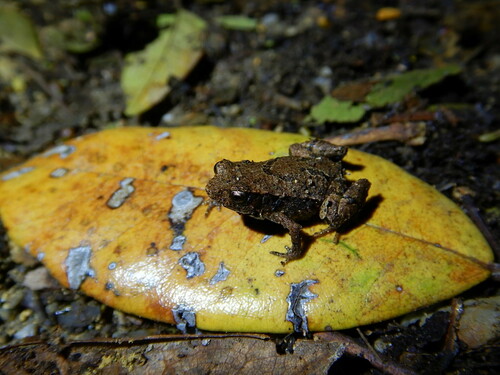
Mixophyes fleayi is a large, robust ground-dwelling frog distinguished by prominent bony ridges above its eyes, mottled brown and grey dorsal camouflage, and a pale barred pattern on its hind limbs. Females lay eggs in shallow riffle sections of streams, and tadpoles develop in flowing water before emerging as juveniles that disperse into surrounding forest. As both predator and prey, the species contributes to nutrient cycling and food web dynamics within its riparian habitat, and its sensitivity to water quality makes it a useful indicator of stream ecosystem health.
The species is restricted to subtropical rainforest and wet eucalypt forest of the McPherson and Border Ranges, spanning southeastern Queensland and northeastern New South Wales, Australia. It depends on permanent, well-oxygenated streams within intact forest for breeding.
Population decline is driven by chytrid fungus (Batrachochytrium dendrobatidis), a disease that has caused severe amphibian die-offs across the region. Habitat loss from logging, agricultural expansion, and urban development further fragments remaining populations, while altered fire regimes, prolonged drought, and climate-driven shifts in stream flow degrade breeding habitat. Predation and competition from invasive species, along with disturbance from feral pigs and livestock grazing near waterways, add additional pressure.
Conservation efforts include habitat protection within national parks and reserves, disease and population monitoring programs, captive breeding and research initiatives aimed at understanding chytrid resistance, and riparian restoration projects targeting water quality and streamside vegetation. Some populations are also monitored as part of broader regional biodiversity surveillance following bushfire events.
Despite these measures, the species continues to experience population decline, and its restricted range and dependence on disease-free, undisturbed stream habitat leave it vulnerable to ongoing and compounding threats, particularly disease and climate variability.
Fleay's Barred-frog is losing its forest habitat as land is cleared for housing, farming, crops, and logging, while activities like fishing in its streams and disturbances from fire also take a toll. It faces added pressure from diseases and pest species (including introduced predators), and climate-related problems like droughts and shifting weather patterns are making its habitat less livable. With so many ongoing pressures affecting this species at once, the overall threat level appears to be intensifying rather than easing.
Habitat
Conservation measures underway
Other threatened species in MYOBATRACHIDAE

Threatened in Australia
Frequently asked questions
Why is Fleay’s Barred-frog classified as Endangered?
Where does Fleay’s Barred-frog live?
What are the main threats to Fleay’s Barred-frog?
Get weekly conservation intelligence
One short digest a week of the most striking species and country data we ship, plus breaking conservation news paired with our database where it matters.
Free, no spam. One-click unsubscribe in every email.