
Parmelina pastillifera
Photo: Wikimedia Commons (CC) via https://en.wikipedia.org/wiki/Parmelina_pastillifera
Overview
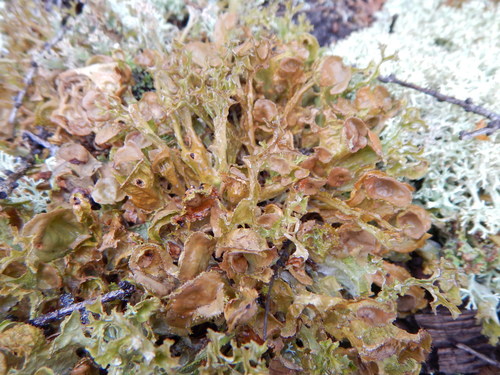
Parmelina pastillifera is a species of foliose lichen in the family Parmeliaceae. The species forms greyish rosettes typically 4–8 cm across on nutrient-rich bark, particularly on ash and maple branches, as well as on rocks and tiles in exposed situations. It is readily identified by its characteristic button-like, blue-black outgrowths (isidia) that cover the lobes and often become dense in the centre of the thallus.
The lichen occurs in Europe and Great Britain, where it is associated with well-lit habitats.
Parmelina pastillifera, known as knopjesschildmos, is critically endangered primarily due to habitat loss from urbanization and agricultural expansion in its limited range in South Africa. Air pollution and climate change are exacerbating the decline of this sensitive lichen species, which requires specific environmental conditions to survive.
Habitat
Parmelina pastillifera occurs in Europe and Great Britain. It grows on well-lit, nutrient-rich or nutrient-enriched bark, particularly on the branches of Fraxinus and Acer, and also grows on siliceous rocks, roof tiles and memorials in similarly exposed positions.
Other threatened species in Parmeliaceae


Threatened in Åland Islands


Frequently asked questions
Why is Parmelina pastillifera classified as Critically Endangered?
Where does Parmelina pastillifera live?
What are the main threats to Parmelina pastillifera?
Get weekly conservation intelligence
One short digest a week of the most striking species and country data we ship, plus breaking conservation news paired with our database where it matters.
Free, no spam. One-click unsubscribe in every email.