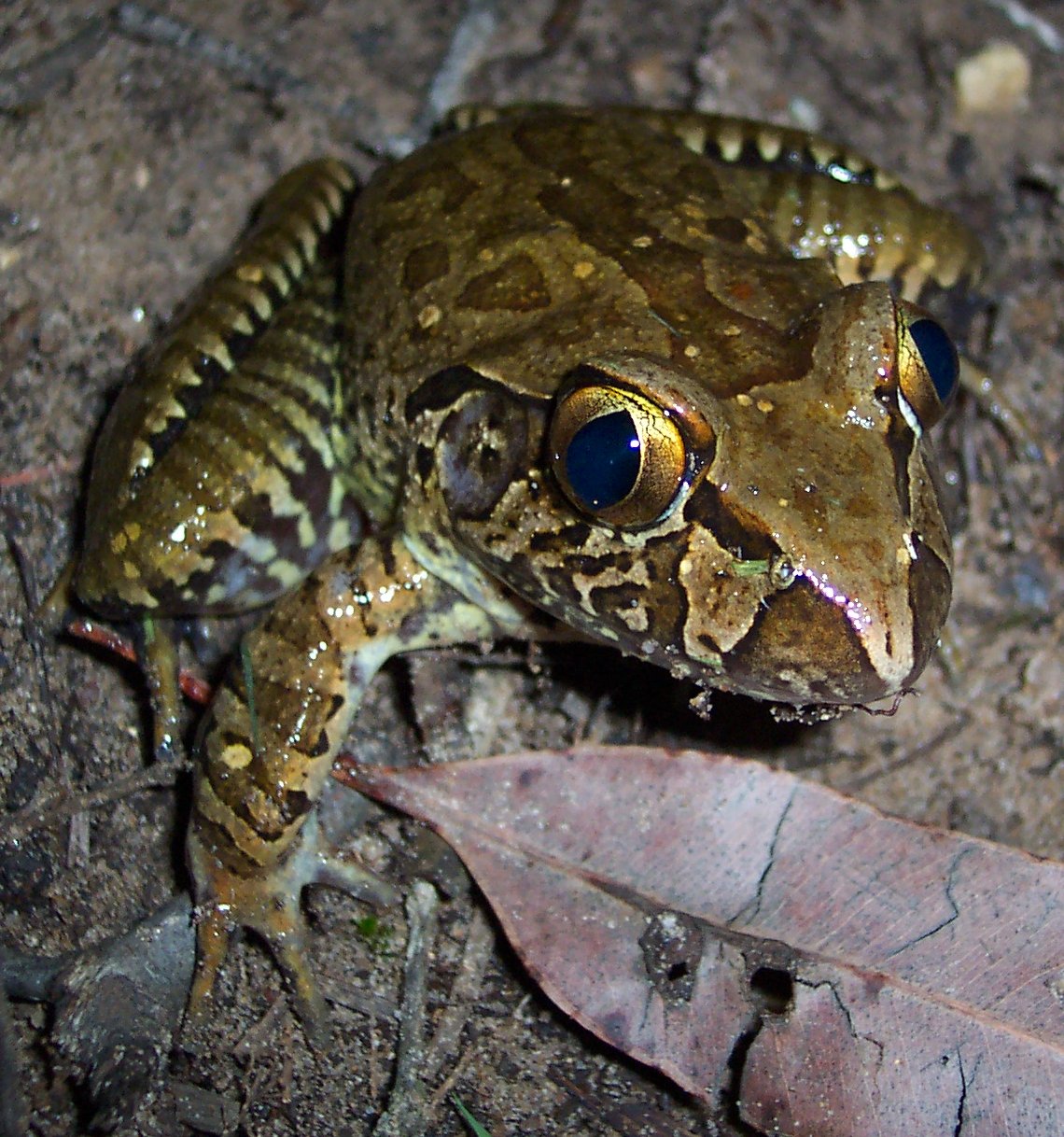
Giant Barred-frog
Mixophyes iteratus
Photo: Wikimedia Commons (CC) via https://en.wikipedia.org/wiki/Giant_barred_frog
Overview
Mixophyes iteratus is one of the largest frog species native to Australia, with females reaching up to 10-12 cm in body length. It has a robust build, mottled brown and grey dorsal colouration for camouflage among leaf litter and stream substrate, and prominent dark eyes with a distinctive barred pattern on the hind limbs, from which its common name derives. Individuals are largely nocturnal, sheltering by day in leaf litter or under vegetation near watercourses and emerging at night to forage on insects, other invertebrates, and smaller frogs.
As both predator and prey within riparian food webs, it contributes to nutrient cycling and serves as an indicator of freshwater ecosystem health, given its sensitivity to water quality and habitat disturbance.
The species occurs along the eastern coast of Australia, spanning subtropical and temperate forests from central Queensland through New South Wales. It is closely tied to permanent streams and rivers within forested catchments, particularly lowland subtropical and tropical moist forest, where breeding occurs in flowing water.
Population decline stems from multiple compounding pressures: land clearing for housing, agriculture, and livestock grazing; logging altering forest structure and stream shading; chytrid fungus infection, a disease severely affecting Australian amphibians; predation and competition from invasive species; and climate-linked stressors including drought and altered fire regimes affecting riparian habitat integrity.
Conservation efforts include habitat protection within reserves, riparian buffer zone management, chytrid fungus research, and captive breeding programs supporting reintroduction planning. Some populations persist within protected forest areas.
Despite these measures, the population trend remains decreasing, and the species' reliance on undisturbed riparian corridors makes recovery contingent on sustained habitat protection and disease management across its fragmented range.
The Giant Barred-frog is mainly threatened by the clearing of its forest habitat for housing, farming, and logging, as well as pollution and disturbance from crop growing and fishing activities near its streams. It also faces pressure from disease, introduced predators and competitors, and changing conditions caused by droughts and fires. These combined pressures appear to be ongoing and stable rather than clearly increasing or decreasing.
Habitat
Conservation measures underway
Other threatened species in MYOBATRACHIDAE

Threatened in Australia
Frequently asked questions
Why is Giant Barred-frog classified as Vulnerable?
Where does Giant Barred-frog live?
What are the main threats to Giant Barred-frog?
Get weekly conservation intelligence
One short digest a week of the most striking species and country data we ship, plus breaking conservation news paired with our database where it matters.
Free, no spam. One-click unsubscribe in every email.