
Exaerete dentata
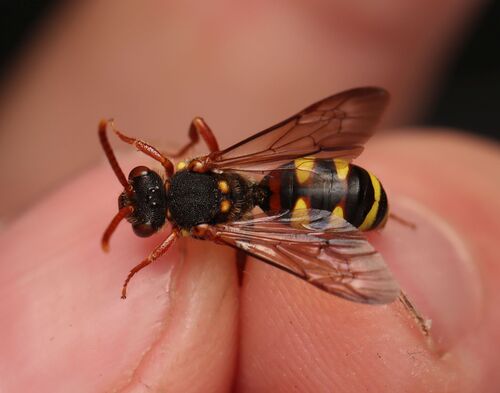
Photo: Wikimedia Commons (CC) via https://en.wikipedia.org/wiki/Exaerete_dentata
Overview
Exaerete dentata is a species of cuckoo bee belonging to the orchid bee tribe Euglossini, found in the tropical regions of Central and South America. These large, robust bees are cleptoparasites, meaning they do not collect pollen or nectar themselves but instead lay their eggs in the nests of other orchid bee species, particularly those in the genus Eulaema. The larvae then consume the host's provisions intended for their own offspring.
Exaerete dentata is distinguished by its dark metallic coloration and distinctive dental-like projections on the mandibles, which give the species its name. The species inhabits lowland and montane tropical forests where their host bees are present, typically in areas with abundant orchid populations that serve as nectar sources for the host species. The bee's distribution includes countries such as Costa Rica, Panama, Colombia, Ecuador, Peru, and parts of Brazil.
The species faces significant threats from widespread deforestation and habitat fragmentation throughout its range, which reduces both the availability of suitable nesting sites for host species and the diversity of orchid species that support the broader orchid bee community. Climate change may also be affecting the delicate ecological relationships between the parasitic bee, its hosts, and the plant species they depend upon. Currently classified as Critically Endangered, Exaerete dentata requires immediate conservation attention, though specific conservation programs targeting this species are limited.
Protection of remaining tropical forest habitats and restoration of degraded areas are essential for the species' survival.
Exaerete dentata faces severe threats from deforestation and habitat fragmentation across its tropical forest range, which eliminates both host bee nesting sites and the orchid species that support the ecosystem. Climate change may be disrupting the complex ecological relationships between this parasitic bee, its host species, and their shared plant resources.
Habitat
This species inhabits lowland and montane tropical forests in Central and South America, where it depends on the presence of host orchid bee species and diverse orchid populations. The bee requires intact forest ecosystems that support the complex web of relationships between orchid bees and their associated plant species.
Other threatened species in Apidae
Threatened in Argentina

Frequently asked questions
Why is Exaerete dentata classified as Critically Endangered?
Where does Exaerete dentata live?
What are the main threats to Exaerete dentata?
Get weekly conservation intelligence
One short digest a week of the most striking species and country data we ship, plus breaking conservation news paired with our database where it matters.
Free, no spam. One-click unsubscribe in every email.