Big-spotted Cleg
ENEndangered

Big-spotted Cleg

Haematopota bigoti

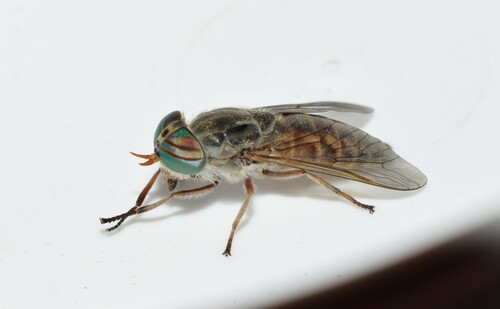
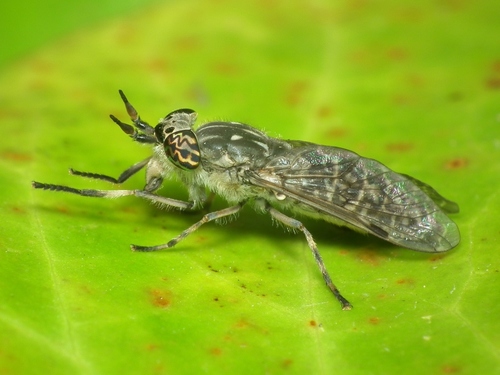
The Big-spotted Cleg (Haematopota bigoti) is a large horse fly species distinguished by its prominent dark spots across pale wings and robust build. As a blood-feeding insect, females play important ecological roles as both disease vectors and prey for various bird and spider species, while also serving as pollinators when feeding on nectar.

10

Countries

Photo: iNaturalist: (c) Rui Andrade, all rights reserved

01Classification

Taxonomy & Classification

Kingdom

Animalia

Phylum

Arthropoda

Class

Insecta

Order

Diptera

Family

Tabanidae

Genus

Haematopota

Big-spotted Cleg belongs to the family Tabanidae, order Diptera, within the Insecta class.

02Description

Species Profile

The Big-spotted Cleg (Haematopota bigoti) is a large horse fly species distinguished by its prominent dark spots across pale wings and robust build. As a blood-feeding insect, females play important ecological roles as both disease vectors and prey for various bird and spider species, while also serving as pollinators when feeding on nectar.

The Big-spotted Cleg (Haematopota bigoti) faces significant population declines primarily due to habitat loss and degradation of its specialized wetland environments. Agricultural intensification, urban development, and climate-induced changes to water regimes have severely reduced the availability of suitable breeding and feeding habitats for this blood-feeding fly species.

Key Facts

IUCN StatusEndangered (EN)
GroupInsects
03Habitat

Habitat & Distribution

Big-spotted Clegs inhabit marshy areas, wet meadows, and the edges of slow-moving streams where females lay eggs in moist soil. Adults are commonly found near grazing areas and woodland clearings where they seek blood meals from livestock and wild mammals.

04Threats

Threats

!

IUCN Red List: Endangered

The Big-spotted Cleg (Haematopota bigoti) faces significant population declines primarily due to habitat loss and degradation of its specialized wetland environments. Agricultural intensification, urban development, and climate-induced changes to water regimes have severely reduced the availability of suitable breeding and feeding habitats for this blood-feeding fly species.

Agricultural intensification and pesticide use

HighOngoing

Wetland habitat loss and drainage

HighOngoing

Climate change affecting water regimes

MediumOngoing

Pollution of aquatic breeding sites

MediumOngoing

Urban and infrastructure development

MediumOngoing
Community

Community Sightings

Report a sighting

No community sightings yet. Be the first to report!

07Sources

Sources & Attribution

How to Cite

IUCN: IUCN (2025). The IUCN Red List of Threatened Species. Version 2025-1. Available at: https://www.iucnredlist.org. doi:10.2305/IUCN.UK.2025-1.RLTS

GBIF: GBIF.org (2025). GBIF Home Page. Available at: https://www.gbif.org

This page: SpeciesRadar (2025). Big-spotted Cleg (Haematopota bigoti). SpeciesRadar: Intelligence for Earth's Biodiversity. Available at: https://speciesradar.org/species/big-spotted-cleg

Full citation guide & data usage terms