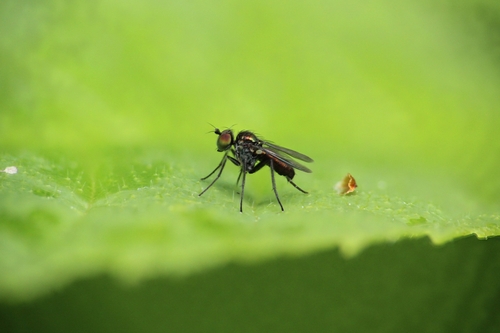
Chrysotus cupreus
Photo: no rights reserved, uploaded by OlleHanna
Overview
Chrysotus cupreus is a small metallic fly belonging to the long-legged fly family Dolichopodidae, characterized by its distinctive copper-bronze coloration that gives the species its name. These diminutive dipterans typically measure 2-4 millimeters in length and display the family's characteristic long legs and iridescent exoskeleton. The species exhibits typical dolichopodid hunting behavior, actively pursuing smaller insects in flight with remarkable agility and precision.
Males perform elaborate courtship displays involving wing positioning and leg movements to attract females during mating season. Chrysotus cupreus inhabits specialized wetland environments, particularly favoring the margins of pristine freshwater streams and seepage areas where organic matter accumulates. The species appears to have an extremely restricted geographic range, likely endemic to specific watershed systems with particular microclimate requirements.
Adults are most active during warmer daylight hours and are believed to be predators of midges, aphids, and other small soft-bodied insects. The International Union for Conservation of Nature has classified this species as Critically Endangered, reflecting the severe threat to its continued survival. Current population trends remain unknown due to limited monitoring data, though the species' specialized habitat requirements suggest high vulnerability to environmental changes.
Recent targeted surveys in potential habitat areas have documented the species' persistence in several protected wetland sites, offering hope for conservation efforts. The discovery of previously unknown populations through citizen science initiatives demonstrates the potential for expanding knowledge of this rare fly's distribution.
The primary threats to Chrysotus cupreus stem from wetland degradation and hydrological alterations within its specialized stream margin habitats. Agricultural runoff and urban development have contaminated the pristine water quality conditions this species requires, while water diversions and dam construction have altered the natural flow regimes essential for maintaining suitable microhabitat conditions. Climate change poses an additional threat through altered precipitation patterns that could disrupt the delicate moisture balance of seepage areas where the species breeds.
Habitat
Chrysotus cupreus occupies the narrow interface between aquatic and terrestrial environments along freshwater stream margins, particularly in areas with consistent moisture from natural seepage. The species requires pristine water quality conditions and appears dependent on specific substrate compositions where organic detritus accumulates to support its prey base.
Other threatened species in Dolichopodidae
Threatened in Åland Islands


Frequently asked questions
Why is Chrysotus cupreus classified as Critically Endangered?
Where does Chrysotus cupreus live?
What are the main threats to Chrysotus cupreus?
Get weekly conservation intelligence
One short digest a week of the most striking species and country data we ship, plus breaking conservation news paired with our database where it matters.
Free, no spam. One-click unsubscribe in every email.