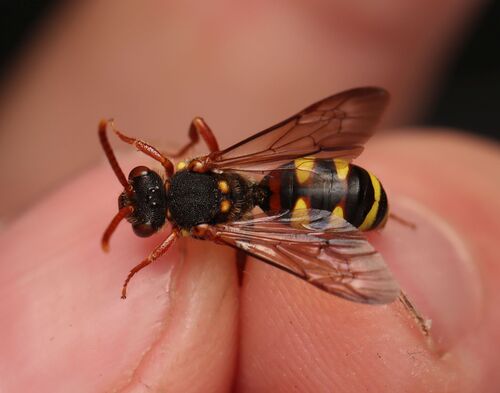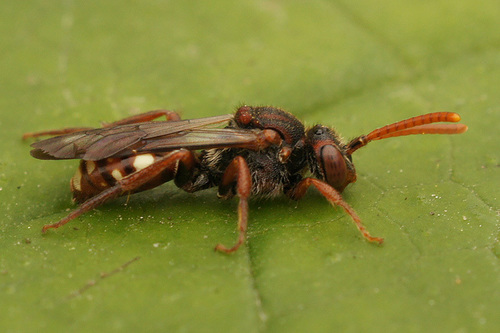
Bear-clawed Nomad Bee
Nomada baccata
The Bear-clawed Nomad Bee (Nomada baccata) is a distinctive cuckoo bee species characterized by its robust, bear-like claws and striking yellow and black coloration. As a brood parasite, it infiltrates the nests of solitary ground-nesting bees, laying its eggs in host cells where its larvae consume the provisions intended for the host's offspring.
17
Countries
Photo: iNaturalist: (c) Henk Wallays, all rights reserved
Taxonomy & Classification
Kingdom
Animalia
Phylum
Arthropoda
Class
Insecta
Order
Hymenoptera
Family
Apidae
Genus
Nomada
Bear-clawed Nomad Bee belongs to the family Apidae, order Hymenoptera, within the Insecta class.
Species Profile
The Bear-clawed Nomad Bee (Nomada baccata) is a distinctive cuckoo bee species characterized by its robust, bear-like claws and striking yellow and black coloration. As a brood parasite, it infiltrates the nests of solitary ground-nesting bees, laying its eggs in host cells where its larvae consume the provisions intended for the host's offspring. This specialized parasitic lifestyle makes it entirely dependent on healthy populations of its specific host bee species.
The Bear-clawed Nomad Bee faces severe population declines primarily due to habitat loss from agricultural intensification and urban development, which destroys the specialized nesting sites of its host bee species. Climate change and pesticide use further compound these pressures, disrupting the delicate ecological relationships this parasitic bee depends upon for survival.
Key Facts
Habitat & Distribution
This species inhabits sandy heathlands, coastal dunes, and chalk downlands where its host bees construct their underground nests. It requires areas with sparse vegetation and exposed soil patches that provide optimal nesting conditions for ground-dwelling solitary bees.
Threats
IUCN Red List: Critically Endangered
The Bear-clawed Nomad Bee faces severe population declines primarily due to habitat loss from agricultural intensification and urban development, which destroys the specialized nesting sites of its host bee species. Climate change and pesticide use further compound these pressures, disrupting the delicate ecological relationships this parasitic bee depends upon for survival.
Agricultural intensification
Decline of host bee populations
Habitat loss and fragmentation
Climate change impacts
Pesticide use
Found in 17 Countries
National vs Global Threat Status
How this species is assessed at the national level compared to its IUCN global status (CR).
| Country | National Status | Global Status | Comparison |
|---|---|---|---|
| EU | NTNear Threatened | CRCritically Endangered | Lower local risk |
National Red List data sourced from the National Red List Project (nationalredlist.org, ZSL) and country-specific Red List authorities.
Community Sightings
Report a sightingNo community sightings yet. Be the first to report!
Sources & Attribution
How to Cite
IUCN: IUCN (2025). The IUCN Red List of Threatened Species. Version 2025-1. Available at: https://www.iucnredlist.org. doi:10.2305/IUCN.UK.2025-1.RLTS
GBIF: GBIF.org (2025). GBIF Home Page. Available at: https://www.gbif.org
National Red Lists: ZSL (2025). National Red List. Zoological Society of London. Available at: https://www.nationalredlist.org
This page: SpeciesRadar (2025). Bear-clawed Nomad Bee (Nomada baccata). SpeciesRadar: Intelligence for Earth's Biodiversity. Available at: https://speciesradar.org/species/bear-clawed-nomad-bee