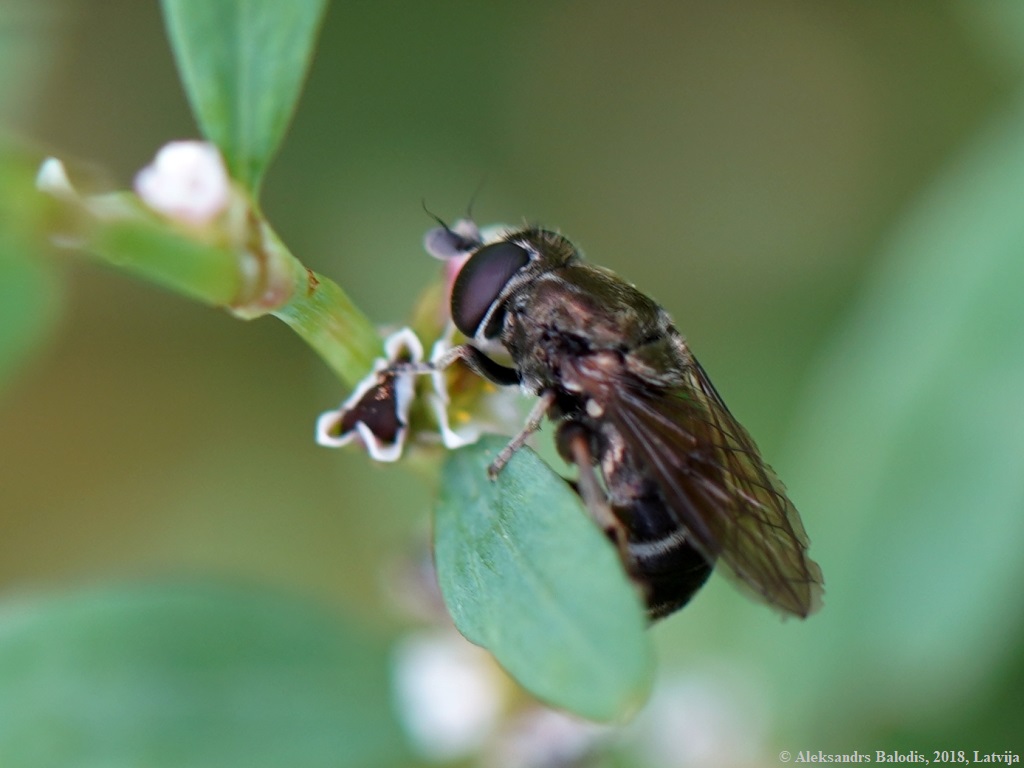
Artiskok-urtesvirreflue
VUVulnerable

Artiskok-urtesvirreflue

Cheilosia vulpina

Cheilosia vulpina is a distinctive hoverfly species with a robust, hairy body and metallic sheen that mimics bees in appearance. This specialized pollinator plays a crucial ecological role in alpine and subalpine ecosystems, particularly in the pollination of Asteraceae family plants including its host plant, the globe artichoke thistle.

22

Countries

Photo: Wikimedia Commons (CC) via https://en.wikipedia.org/wiki/Cheilosia_vulpina

01Classification

Taxonomy & Classification

Kingdom

Animalia

Phylum

Arthropoda

Class

Insecta

Order

Diptera

Family

Syrphidae

Genus

Cheilosia

Artiskok-urtesvirreflue belongs to the family Syrphidae, order Diptera, within the Insecta class.

02Description

Species Profile

Cheilosia vulpina is a distinctive hoverfly species with a robust, hairy body and metallic sheen that mimics bees in appearance. This specialized pollinator plays a crucial ecological role in alpine and subalpine ecosystems, particularly in the pollination of Asteraceae family plants including its host plant, the globe artichoke thistle.

Cheilosia vulpina faces significant threats from habitat loss and degradation due to agricultural intensification and urbanization affecting its specialized woodland and forest edge habitats. Climate change poses additional risks by altering the phenology of host plants and disrupting the delicate timing between adult emergence and larval food availability. The species' dependence on specific plant hosts makes it particularly vulnerable to environmental changes.

Key Facts

IUCN StatusVulnerable (VU)
GroupInsects
03Habitat

Habitat & Distribution

Deciduous and mixed woodlands, forest edges, and clearings where adults feed on flowers and larvae develop in the stems and roots of specific umbelliferous plants. The species is typically found in semi-natural habitats with diverse flowering plant communities at elevations up to 1000m.

04Threats

Threats

Habitat loss from agricultural intensification

HighOngoing

Woodland fragmentation and degradation

HighOngoing

Climate change affecting host plant phenology

MediumOngoing

Loss of traditional forest management practices

MediumOngoing

Urbanization and development pressure

MediumOngoing
07National Status

National vs Global Threat Status

How this species is assessed at the national level compared to its IUCN global status (VU).

CountryNational StatusGlobal StatusComparison
EULCLeast ConcernVUVulnerableLower local risk

National Red List data sourced from the National Red List Project (nationalredlist.org, ZSL) and country-specific Red List authorities.

Community

Community Sightings

Report a sighting

No community sightings yet. Be the first to report!

07Sources

Sources & Attribution

How to Cite

IUCN: IUCN (2025). The IUCN Red List of Threatened Species. Version 2025-1. Available at: https://www.iucnredlist.org. doi:10.2305/IUCN.UK.2025-1.RLTS

GBIF: GBIF.org (2025). GBIF Home Page. Available at: https://www.gbif.org

National Red Lists: ZSL (2025). National Red List. Zoological Society of London. Available at: https://www.nationalredlist.org

This page: SpeciesRadar (2025). Artiskok-urtesvirreflue (Cheilosia vulpina). SpeciesRadar: Intelligence for Earth's Biodiversity. Available at: https://speciesradar.org/species/artiskok-urtesvirreflue

Full citation guide & data usage terms