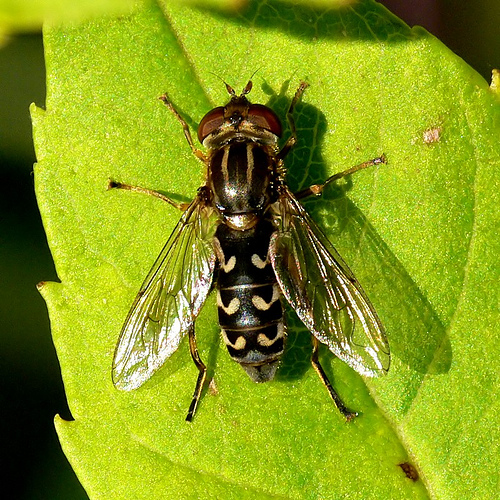
ingesnoerde waterzweefvlieg
Anasimyia contracta
Anasimyia contracta is a distinctive hoverfly species with a compact, robust body and characteristic yellow and black markings that distinguish it from related water-associated hoverflies. This aquatic-breeding syrphid fly plays an important ecological role as both a pollinator of wetland plants in its adult stage and as a filter-feeder in aquatic ecosystems during its larval development.
23
Countries
Photo: Wikimedia Commons (CC) via https://en.wikipedia.org/wiki/Anasimyia_contracta
Taxonomy & Classification
Kingdom
Animalia
Phylum
Arthropoda
Class
Insecta
Order
Diptera
Family
Syrphidae
Genus
Anasimyia
ingesnoerde waterzweefvlieg belongs to the family Syrphidae, order Diptera, within the Insecta class.
Species Profile
Anasimyia contracta is a distinctive hoverfly species with a compact, robust body and characteristic yellow and black markings that distinguish it from related water-associated hoverflies. This aquatic-breeding syrphid fly plays an important ecological role as both a pollinator of wetland plants in its adult stage and as a filter-feeder in aquatic ecosystems during its larval development. The larvae are semi-aquatic, living in organically rich water where they help process decaying plant matter.
Anasimyia contracta is declining primarily due to habitat loss and degradation of wetland ecosystems. The species is particularly vulnerable to water pollution, drainage of wetlands, and changes in water quality that affect the aquatic environments where its larvae develop.
Key Facts
Habitat & Distribution
This species inhabits shallow, nutrient-rich wetlands including pond margins, ditches, and slow-flowing streams with abundant organic matter and emergent vegetation. The larvae specifically require clean to moderately polluted standing or slow-moving water bodies with decaying plant material.
Threats
IUCN Red List: Endangered
Anasimyia contracta is declining primarily due to habitat loss and degradation of wetland ecosystems. The species is particularly vulnerable to water pollution, drainage of wetlands, and changes in water quality that affect the aquatic environments where its larvae develop.
Water pollution and eutrophication
Wetland habitat loss and drainage
Agricultural intensification near breeding sites
Climate change affecting water levels
Found in 23 Countries
National vs Global Threat Status
How this species is assessed at the national level compared to its IUCN global status (EN).
| Country | National Status | Global Status | Comparison |
|---|---|---|---|
| EU | LCLeast Concern | ENEndangered | Lower local risk |
| EU | LCLeast Concern | ENEndangered | Lower local risk |
National Red List data sourced from the National Red List Project (nationalredlist.org, ZSL) and country-specific Red List authorities.
Community Sightings
Report a sightingNo community sightings yet. Be the first to report!
Sources & Attribution
How to Cite
IUCN: IUCN (2025). The IUCN Red List of Threatened Species. Version 2025-1. Available at: https://www.iucnredlist.org. doi:10.2305/IUCN.UK.2025-1.RLTS
GBIF: GBIF.org (2025). GBIF Home Page. Available at: https://www.gbif.org
National Red Lists: ZSL (2025). National Red List. Zoological Society of London. Available at: https://www.nationalredlist.org
This page: SpeciesRadar (2025). ingesnoerde waterzweefvlieg (Anasimyia contracta). SpeciesRadar: Intelligence for Earth's Biodiversity. Available at: https://speciesradar.org/species/ingesnoerde-waterzweefvlieg