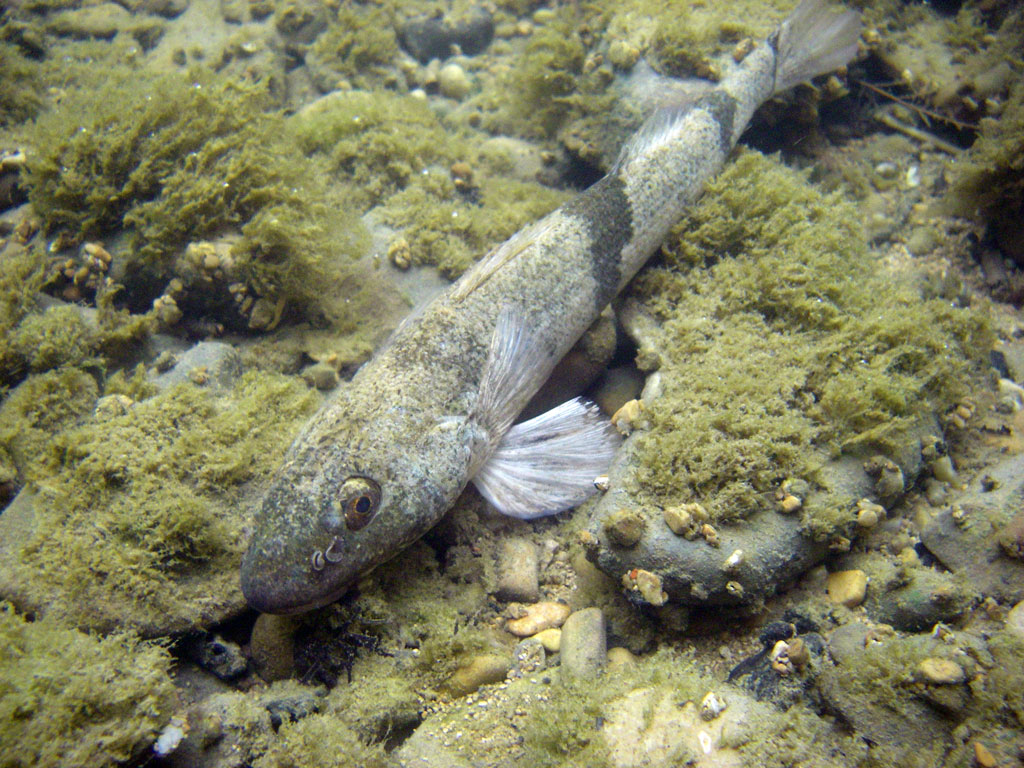
Zingel asper
ENEndangered

Zingel asper

**Apron (Zingel asper)** The Apron is a small freshwater fish endemic to the Rhône River basin in France and Switzerland. This slender percid typically measures 12-22 cm in length, characterized by its elongated body, large pectoral fins, and distinctive spotted pattern along its flanks.

Decreasing

Population trend

5

Countries

Photo: Wikimedia Commons (CC) via https://en.wikipedia.org/wiki/Zingel_asper

01Classification

Taxonomy & Classification

Kingdom

ANIMALIA

Phylum

CHORDATA

Class

ACTINOPTERYGII

Order

PERCIFORMES

Family

PERCIDAE

Genus

Zingel

Zingel asper belongs to the family PERCIDAE, order PERCIFORMES, within the ACTINOPTERYGII class.

02Description

Species Profile

**Apron (Zingel asper)** The Apron is a small freshwater fish endemic to the Rhône River basin in France and Switzerland. This slender percid typically measures 12-22 cm in length, characterized by its elongated body, large pectoral fins, and distinctive spotted pattern along its flanks. The species exhibits benthic behavior, dwelling on rocky substrates where it feeds primarily on aquatic invertebrates, particularly mayfly and caddisfly larvae. As a specialized predator, the Apron plays an important role in maintaining the ecological balance of fast-flowing river ecosystems. Historically distributed throughout the upper Rhône basin, the Apron's range has contracted dramatically to just four river systems: the Rhône, Ain, Ardèche, and Durance rivers in France, plus the Doubs River on the French-Swiss border. The species requires well-oxygenated waters with strong currents and rocky or gravelly substrates, typically in river sections with depths of 0.5-3 meters. The Apron faces severe threats from habitat degradation caused by dam construction, river channelization, and water extraction, which have fragmented populations and altered natural flow regimes. Water pollution, particularly from agricultural runoff and urban discharge, has further compromised water quality in remaining habitats. Conservation efforts include habitat restoration projects, fish passage construction around dams, and captive breeding programs. French authorities have implemented protective legislation and established monitoring protocols to track remaining populations. The species' outlook remains precarious due to its extremely limited range and ongoing habitat pressures. Without sustained conservation intervention, the Apron faces a high risk of extinction within the coming decades.

Based on the available data, the specific threats facing the Apron (Zingel asper) have not been formally assessed or documented. Without this threat assessment information, it's not possible to identify what particular dangers this species faces or describe how human activities or environmental changes might be affecting its populations. The status of whether threats are increasing, stable, or decreasing cannot be determined without proper threat evaluation data.

Key Facts

IUCN StatusEndangered (EN)
TrendDecreasing
GroupFishes
03Habitat

Habitat & Distribution

Wetlands (inland) - Permanent rivers/streamsMajor
04Threats

Threats

!

IUCN Red List: Endangered

Based on the available data, the specific threats facing the Apron (Zingel asper) have not been formally assessed or documented. Without this threat assessment information, it's not possible to identify what particular dangers this species faces or describe how human activities or environmental changes might be affecting its populations. The status of whether threats are increasing, stable, or decreasing cannot be determined without proper threat evaluation data.

Agricultural & forestry effluents

Ongoing

Annual & perennial non-timber crops

Ongoing

Dams & water management/use

Ongoing

Domestic & urban waste water

Ongoing

Fishing & harvesting aquatic resources

Ongoing

Habitat shifting & alteration

Ongoing

Housing & urban areas

Ongoing

Invasive non-native/alien species/diseases

Ongoing

Livestock farming & ranching

Ongoing

Recreational activities

Ongoing

Renewable energy

Ongoing

Type Unknown/Unrecorded (pollution)

Ongoing
05Conservation

Conservation Actions

Habitat & natural process restoration
Species management
Species recovery
Ex-situ conservation
Awareness & communications
Legislation
Policies and regulations
06Range

Found in 5 Countries

07National Status

National vs Global Threat Status

How this species is assessed at the national level compared to its IUCN global status (EN).

CountryNational StatusGlobal StatusComparison
EUCRCritically EndangeredENEndangeredHigher local risk

National Red List data sourced from the National Red List Project (nationalredlist.org, ZSL) and country-specific Red List authorities.

Community

Community Sightings

Report a sighting

No community sightings yet. Be the first to report!

07Sources

Sources & Attribution

How to Cite

IUCN: IUCN (2025). The IUCN Red List of Threatened Species. Version 2025-1. Available at: https://www.iucnredlist.org. doi:10.2305/IUCN.UK.2025-1.RLTS

GBIF: GBIF.org (2025). GBIF Home Page. Available at: https://www.gbif.org

National Red Lists: ZSL (2025). National Red List. Zoological Society of London. Available at: https://www.nationalredlist.org

This page: SpeciesRadar (2026). Zingel asper (Zingel asper). SpeciesRadar: Intelligence for Earth's Biodiversity. Available at: https://speciesradar.org/species/apron

Full citation guide & data usage terms