
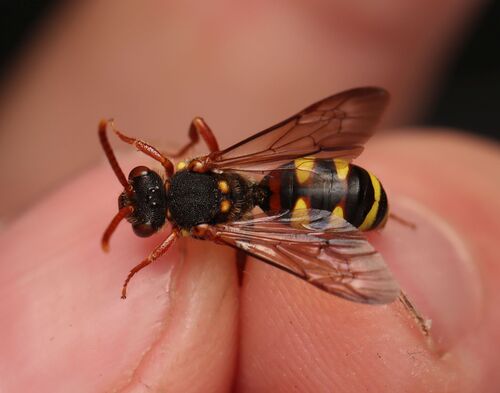
Yellow-legged Nomad Bee
Nomada succincta
Photo: Wikimedia Commons (CC) via https://en.wikipedia.org/wiki/Nomada_succincta
Overview
The Yellow-legged Nomad Bee (Nomada succincta) is a cleptoparasitic bee species belonging to the cuckoo bee family. These small, wasp-like bees are characterized by their distinctive yellow legs and black and yellow striped abdomen. As cleptoparasites, they do not collect pollen themselves but instead lay their eggs in the nests of other solitary bee species, where their larvae consume the host's provisions.
Yellow-legged Nomad Bees are found across parts of Europe, with historical records from various countries including the United Kingdom, where they have experienced severe population declines. The species typically parasitizes mining bees (Andrena species) and requires proximity to active host colonies for successful reproduction. Their flight period generally occurs during spring and early summer months when host species are most active.
The species faces significant conservation challenges due to habitat loss, agricultural intensification, and the decline of their host bee populations. Urban development and changes in land management practices have reduced the availability of suitable nesting sites for both the nomad bees and their hosts. Climate change may also be affecting the synchronization between the Yellow-legged Nomad Bee's lifecycle and that of its host species.
Conservation efforts focus on habitat restoration, creating pollinator-friendly environments, and monitoring remaining populations. The species' dependence on other bee species makes its conservation particularly complex, requiring protection of entire pollinator communities rather than single-species approaches.
The Yellow-legged Nomad Bee faces threats from habitat loss due to agricultural intensification and urban development, which reduces nesting opportunities for both the species and its host bees. The decline of host bee populations directly impacts this cleptoparasitic species' ability to reproduce successfully. Climate change may disrupt the timing between the nomad bee's lifecycle and its host species' activity periods.
Habitat
Yellow-legged Nomad Bees inhabit areas where their host mining bee species are present, including grasslands, heathlands, coastal dunes, and garden environments with suitable nesting substrates. They require proximity to sandy or bare soil areas where host bees excavate their nests.
Other threatened species in Apidae
Threatened in Austria
Frequently asked questions
Why is Yellow-legged Nomad Bee classified as Critically Endangered?
Where does Yellow-legged Nomad Bee live?
What are the main threats to Yellow-legged Nomad Bee?
Get weekly conservation intelligence
One short digest a week of the most striking species and country data we ship, plus breaking conservation news paired with our database where it matters.
Free, no spam. One-click unsubscribe in every email.