
2-spot Ladybird
Adalia bipunctata
Photo: Wikimedia Commons (CC) via https://en.wikipedia.org/wiki/Adalia_bipunctata
Overview
Adalia bipunctata is a small beetle within the family Coccinellidae, easily recognised by its domed, glossy elytra, most commonly red with two black spots, though numerous colour morphs exist, including melanic forms with black elytra bearing red markings. Both adults and larvae are predatory, feeding primarily on aphids and other soft-bodied insects, making the species a significant natural control agent in gardens, orchards, forests, and agricultural land. Adults overwinter in bark crevices, leaf litter, or man-made structures, emerging in spring to breed.
The species has an exceptionally wide geographic distribution, occurring across Europe, much of Asia, North Africa, North America, South America, Australia, New Zealand, and parts of southern Africa, reflecting both native range and introductions. It occupies a broad range of terrestrial habitats, from woodlands and hedgerows to urban parks and gardens, wherever aphid prey is available.
Population declines in parts of its range have been linked to several concurrent pressures. Competition from invasive alien species, notably the harlequin ladybird (Harmonia axyridis), has displaced native populations in many regions. Agricultural pesticide use reduces both the beetle and its prey base, while urban development fragments suitable habitat.
Shifts in seasonal timing linked to climate change can desynchronise the beetle's life cycle from aphid availability, compounding prey depletion.
Conservation responses include monitoring programmes tracking distribution and abundance, research into interactions with invasive competitors, and habitat-supportive measures such as reduced pesticide use and maintenance of hedgerows and green corridors in agricultural and urban settings. No population figures are currently available, and the population trend is listed as unknown. The species remains widespread, but continued monitoring is needed to clarify its trajectory.
The 2-spot Ladybird faces competition from invasive ladybird species (such as the Harlequin Ladybird) that outcompete and even prey on it, along with harm from pesticides sprayed on farms and a shrinking food supply of aphids. It's also losing suitable living space as cities expand and green areas become fragmented, while shifting seasonal timing caused by climate change is throwing off the synchronization between its life cycle and its food sources. Overall, these combined pressures appear to be intensifying rather than easing.
Habitat
The Twospotted Lady Beetle inhabits a diverse range of environments including deciduous and mixed forests, urban parks, gardens, agricultural fields, and grasslands where aphid populations are abundant. The species shows particular preference for areas with diverse plant communities that support varied aphid species, and requires suitable overwintering sites such as leaf litter, bark crevices, and building structures.
Other threatened species in Coccinellidae

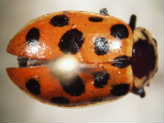

Threatened in Åland Islands


Frequently asked questions
Why is 2-spot Ladybird classified as Vulnerable?
Where does 2-spot Ladybird live?
What are the main threats to 2-spot Ladybird?
Get weekly conservation intelligence
One short digest a week of the most striking species and country data we ship, plus breaking conservation news paired with our database where it matters.
Free, no spam. One-click unsubscribe in every email.