
Sunset Frog
Spicospina flammocaerulea
Photo: Wikimedia Commons (CC) via https://en.wikipedia.org/wiki/Spicospina
Overview
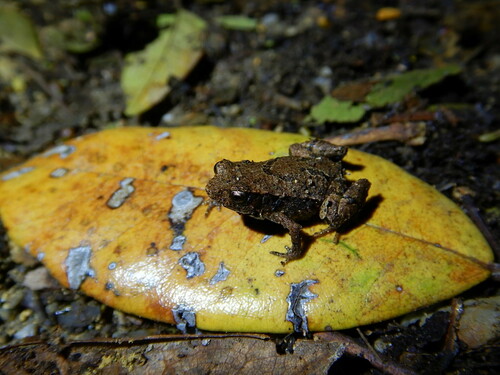
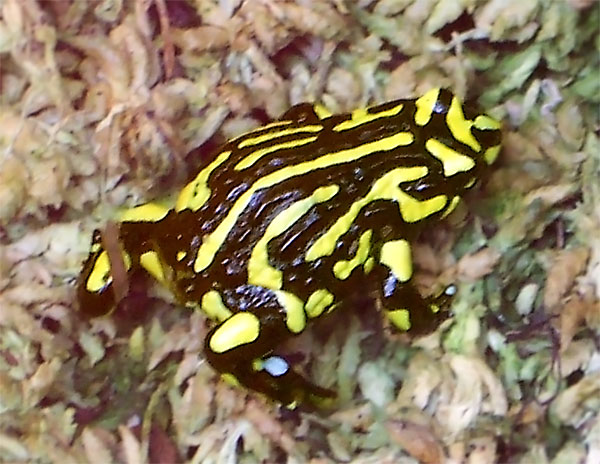
Spicospina flammocaerulea is a small, distinctively marked frog, recognizable by its black body patterned with vivid yellow-orange and blue-green blotches, a coloration that gives the species its common name. It is the sole member of its genus, an evolutionarily distinct lineage within the family Myobatrachidae. Adults are typically found near seepage areas and slow-moving water, where males call from concealed positions among sedges and peat to attract mates.
Tadpoles develop slowly, sometimes over more than a year, in these nutrient-poor, tannin-stained waters, and the species likely plays a role in local invertebrate food webs as both predator and prey.
The species is restricted to a small area of southwestern Australia, where it inhabits permanent streams, seepages, and peaty wetlands within a landscape otherwise dominated by drier habitat types. Its range is naturally limited, making it especially vulnerable to localized disturbance.
Threats include altered hydrology from dams and water management, habitat degradation linked to livestock grazing and agricultural land use, changes in fire regimes, and encroaching urban development. Invasive species and disease, including chytrid fungus risk, further threaten populations, as does pollution of waterways. Climate-related shifts in rainfall and increased storm and flooding events add additional pressure on breeding sites.
Conservation efforts include population monitoring, habitat protection within reserves, and research into the species' breeding ecology and disease susceptibility. Some populations occur within protected areas, offering partial refuge from land-use pressures.
Given its restricted range, ongoing habitat alteration, and multiple compounding threats, the species' population trend remains decreasing, and its long-term outlook depends heavily on continued habitat protection and hydrological stability across its limited range.
The Sunset Frog's wetland habitat is being altered by farming, grazing, and changes to water flow from dams and water management, while urban development and crop farming also encroach on its living space. Wildfires, unusual flooding patterns, pollution, and pressure from invasive species and diseases (as well as native species that have become problematic) add further strain to its survival. These threats are ongoing and show no signs of easing, suggesting a stable but persistent level of risk to the species.
Habitat
Conservation measures underway
Other threatened species in MYOBATRACHIDAE

Threatened in Australia
Frequently asked questions
Why is Sunset Frog classified as Endangered?
Where does Sunset Frog live?
What are the main threats to Sunset Frog?
Get weekly conservation intelligence
One short digest a week of the most striking species and country data we ship, plus breaking conservation news paired with our database where it matters.
Free, no spam. One-click unsubscribe in every email.