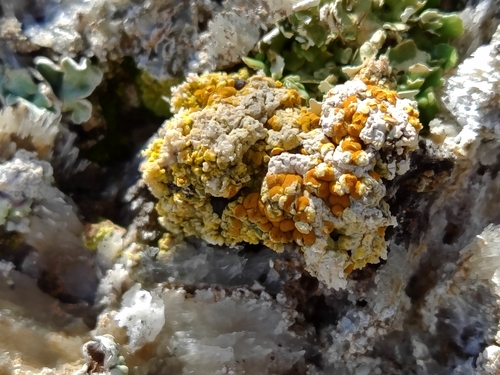
Desert Sulphur Lichen
Gyalolechia desertorum
Photo: Photo: (c) Samuel Santos García, all rights reserved, uploaded by Samuel Santos García
Overview
IUCN Status: Critically Endangered
The Desert Sulphur Lichen is a crustose lichen belonging to the genus *Gyalolechia*, distinguished by its characteristic yellow-orange pigmentation derived from anthraquinone compounds, an adaptation believed to provide protection against intense solar radiation. Like other lichens, it exists as a composite organism formed through the symbiotic association of a fungal partner (mycobiont) and a photosynthetic partner (photobiont, typically algae or cyanobacteria). It grows slowly on rock surfaces and soil crusts in arid and semi-arid environments, contributing to biological soil crust formation, which helps stabilize substrate, limit erosion, and facilitate nutrient cycling in nutrient-poor dryland ecosystems.
This species has an exceptionally wide but fragmented terrestrial distribution, with recorded occurrences across dozens of countries spanning Europe, North Africa, the Middle East, Central Asia, North America, and even Antarctica. It is typically associated with arid, semi-arid, and cold-desert terrestrial habitats, including exposed rock and soil surfaces.
The species faces multiple concurrent, ongoing pressures: overgrazing by livestock damages soil crusts and rock-associated substrates it depends on; agricultural expansion and land conversion reduce available habitat; climate change is altering precipitation patterns critical to lichen hydration cycles; habitat fragmentation isolates populations; and nitrogen deposition from air pollution alters soil and substrate chemistry in ways that disadvantage lichen communities adapted to nutrient-poor conditions.
Population trends remain unknown, and no specific population figures are documented, reflecting broader challenges in monitoring lichen species compared to more visible flora and fauna. Conservation efforts are limited but generally fall under broader dryland habitat protection and biological soil crust research initiatives. Given the combination of multiple ongoing threats and insufficient monitoring data, the species' trajectory remains uncertain but concerning.
The Desert Sulphur Lichen is under pressure from too much livestock grazing trampling and destroying its habitat, along with land being cleared and converted for farming. It also faces problems from changing rainfall patterns linked to climate change, its habitat becoming broken up into smaller isolated patches, and pollution from nitrogen in the air settling on the areas where it grows. All five of these threats are currently ongoing, suggesting the pressures on this lichen are stable to intensifying rather than easing up.
Habitat
This crustose lichen species inhabits exposed calcareous rocks, limestone outcrops, and weathered stone surfaces in arid and semi-arid steppe environments. It typically occurs on sun-exposed substrates in desert margins and dry grassland areas with low annual precipitation.
Other threatened species in Teloschistaceae

Threatened in Antarctica



Frequently asked questions
Why is Desert Sulphur Lichen classified as Critically Endangered?
Where does Desert Sulphur Lichen live?
What are the main threats to Desert Sulphur Lichen?
Get weekly conservation intelligence
One short digest a week of the most striking species and country data we ship, plus breaking conservation news paired with our database where it matters.
Free, no spam. One-click unsubscribe in every email.