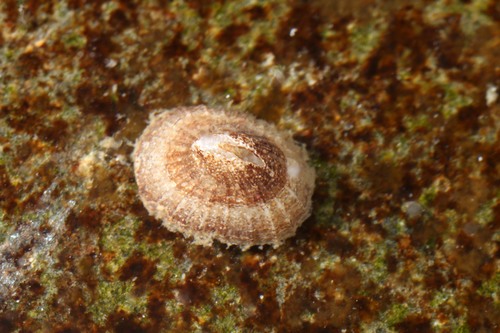
Noah's Keyhole Limpet
Puncturella noachina
Photo: iNaturalist: (c) Terry Gosliner, all rights reserved, uploaded by Terry Gosliner
Overview
Puncturella noachina is a small marine gastropod in the family Fissurellidae, distinguished by a conical, ribbed shell perforated near its apex by a keyhole-shaped opening used to expel respiratory and waste products. Like other keyhole limpets, it is a grazer, using its radula to scrape algae, biofilm, and encrusting organisms from hard substrates. In doing so it contributes to the turnover of microalgal films on rocky surfaces and serves as a prey item for small predators within benthic marine communities.
The species has an unusually wide, cold-water-associated distribution, recorded from the North Atlantic, Arctic, and Southern Ocean regions, including Norway, Iceland, Greenland, Svalbard, the United Kingdom, Canada, and the United States, as well as more scattered occurrences reported from South America, the southern Indo-Pacific, and sub-Antarctic islands. It inhabits hard marine substrates, typically attaching to rock and shell surfaces in subtidal to deeper shelf waters.
No reliable population figures are available, and the population trend is currently listed as unknown. The species faces a combination of ongoing pressures: ocean acidification, which can weaken calcium carbonate shell structures; rising sea temperatures; coastal development and associated habitat degradation; marine pollution; and localized overharvesting by shell collectors.
Specific, targeted conservation programs for this species have not been widely documented; measures affecting it are largely indirect, arising from broader marine protected area networks, water quality regulations, and international efforts to curb greenhouse gas emissions and ocean acidification. Given the combination of multiple compounding stressors and the absence of population monitoring data, the species' conservation trajectory remains uncertain, and its current Endangered classification reflects significant concern despite limited quantitative data.
Noah's Keyhole Limpet faces mounting pressure from rising ocean acidity and warming seawater, both of which can weaken its shell and disrupt the marine habitats it depends on. Coastal construction is destroying the rocky shoreline areas where it lives, while pollution from runoff and waste further degrades its environment, and some populations are also being reduced by collectors gathering the species directly from the wild. Since all of these threats are currently ongoing and linked to broader global changes in climate and coastal development, the overall pressure on this species appears to be intensifying rather than easing.
Habitat
Threatened in Antarctica


Frequently asked questions
Why is Noah's Keyhole Limpet classified as Endangered?
Where does Noah's Keyhole Limpet live?
What are the main threats to Noah's Keyhole Limpet?
Get weekly conservation intelligence
One short digest a week of the most striking species and country data we ship, plus breaking conservation news paired with our database where it matters.
Free, no spam. One-click unsubscribe in every email.