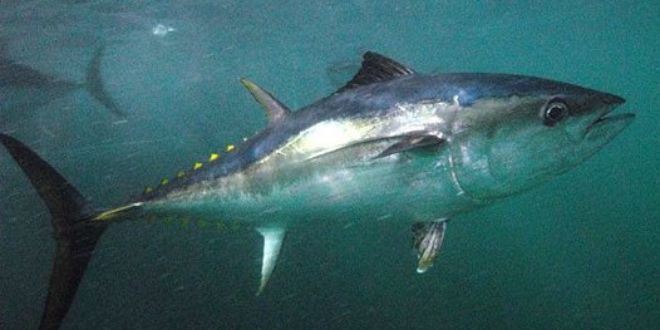
Southern Bluefin Tuna
Thunnus maccoyii
Photo: Wikimedia Commons (CC) via https://en.wikipedia.org/wiki/Southern_bluefin_tuna
Overview
Thunnus maccoyii is a large, fast-swimming pelagic fish within the family Scombridae, recognizable by its streamlined, torpedo-shaped body, dark blue dorsal coloration, and silvery-white flanks. Capable of maintaining body temperatures above that of surrounding water through a specialized circulatory system, it can undertake extensive migrations across open ocean and tolerate a wide range of thermal conditions. As an apex and mid-trophic predator, it feeds on smaller fish, squid, and crustaceans, playing an important role in regulating prey populations within pelagic food webs.
The species inhabits oceanic, neritic, and coastal marine waters primarily across the Southern Hemisphere, with a range spanning the waters off Australia, New Zealand, South Africa, Indonesia, Taiwan, Chile, and French territories including French Polynesia and the French Southern Territories, among other nations bordering its migratory routes.
Historically depleted by decades of intensive commercial fishing targeting its high-value flesh for global sashimi and sushi markets, the species remains under pressure from ongoing wild-capture fishing and from aquaculture operations that rely on wild-caught juveniles for ranching. These practices have historically reduced spawning stock biomass to a small fraction of unfished levels.
Conservation efforts are coordinated primarily through the Commission for the Conservation of Southern Bluefin Tuna, which sets catch quotas among member nations, alongside improved stock monitoring, trade documentation schemes, and quota compliance mechanisms. These measures have contributed to a documented increase in population in recent years.
Despite this positive trend, the species remains classified as Endangered, reflecting the depth of prior depletion and the time required for a slow-maturing, long-lived species to rebuild spawning biomass. Continued adherence to quotas and monitoring will be necessary to sustain recovery.
Southern Bluefin Tuna are mainly threatened by ongoing commercial fishing, where they are caught faster than populations can recover, and by aquaculture operations that capture wild young tuna to raise in pens for market. Both of these pressures continue at present without signs of stopping. Based on the available information, these threats appear to be stable and ongoing rather than clearly increasing or decreasing.
Habitat
Conservation measures underway
Other threatened species in SCOMBRIDAE


Threatened in Australia
Frequently asked questions
Why is Southern Bluefin Tuna classified as Endangered?
Where does Southern Bluefin Tuna live?
What are the main threats to Southern Bluefin Tuna?
Get weekly conservation intelligence
One short digest a week of the most striking species and country data we ship, plus breaking conservation news paired with our database where it matters.
Free, no spam. One-click unsubscribe in every email.