
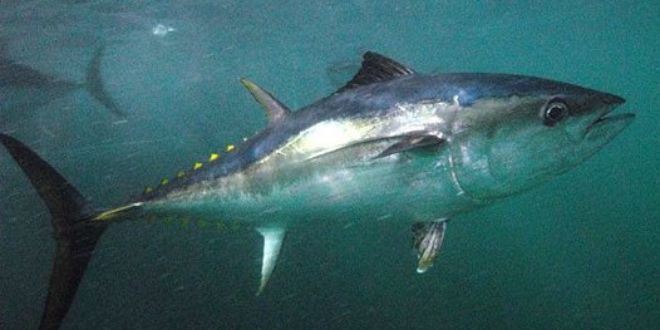
Bigeye Tuna
Thunnus obesus
Photo: Wikimedia Commons (CC) via https://en.wikipedia.org/wiki/Bigeye_tuna
Overview
Bigeye tuna are large, fast-swimming predatory fish distinguished by their notably large eyes, an adaptation that allows them to hunt in the deep, dimly lit waters where they spend much of their time. Adults can exceed 200 kilograms and are built for sustained high-speed swimming, with a streamlined body and countercurrent heat-exchange systems that let them tolerate colder subsurface waters more than other tuna species. They are opportunistic predators, feeding on fish, squid, and crustaceans, and in turn serve as prey for large sharks and toothed whales, making them an important link in open-ocean food webs.
The species has a broad distribution across tropical and subtropical waters of the Atlantic, Indian, and Pacific Oceans, occurring in marine oceanic and neritic zones from the surface to considerable depths. Its range spans coastal and offshore waters of well over a hundred countries and territories, reflecting its highly migratory, wide-ranging behavior.
The principal threat to bigeye tuna is industrial fishing, particularly through longline and purse seine fisheries, much of which targets other tuna species but captures large numbers of bigeye as bycatch or through fish-aggregating devices. Sustained high fishing pressure across its range has driven population declines, and current trends remain downward.
Management responses include catch limits, quotas, and monitoring programs implemented by regional fisheries management organizations overseeing tuna stocks in each ocean basin, along with restrictions on fish-aggregating device use in some fisheries. Enforcement and compliance vary considerably by region.
Despite these measures, bigeye tuna populations continue to decline in many areas, and the species remains classified as vulnerable, with its long-term recovery dependent on more consistent international fisheries management.
Bigeye Tuna are primarily threatened by ongoing commercial fishing, including large-scale purse seine and longline fishing operations that target this species across the world's oceans. This continuous harvesting pressure can reduce population numbers faster than the fish can reproduce and replenish their numbers. Based on the available data, this fishing pressure remains an ongoing, persistent threat to the species.
Habitat
Conservation measures underway
Other threatened species in SCOMBRIDAE


Threatened in Angola



Frequently asked questions
Why is Bigeye Tuna classified as Vulnerable?
Where does Bigeye Tuna live?
What are the main threats to Bigeye Tuna?
Get weekly conservation intelligence
One short digest a week of the most striking species and country data we ship, plus breaking conservation news paired with our database where it matters.
Free, no spam. One-click unsubscribe in every email.