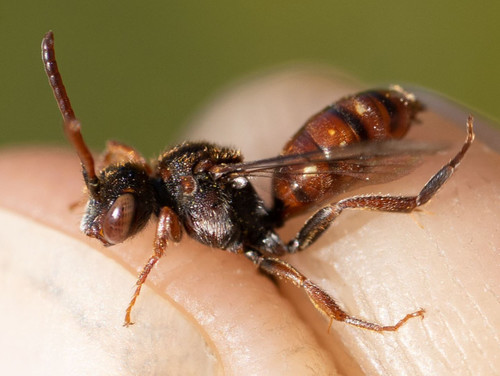
Short-spined Nomad Bee
Nomada guttulata
Photo: Photo: (c) Jens Bokelaar, some rights reserved (CC BY-NC), uploaded by Jens Bokelaar
Overview
The Short-spined Nomad Bee (Nomada guttulata) is a critically endangered cuckoo bee species belonging to the family Apidae. As a cleptoparasitic bee, it does not collect pollen or nectar for its own offspring but instead lays its eggs in the nests of other solitary bee species, where its larvae consume the host's provisions. This species exhibits the characteristic yellow and black coloration typical of Nomada bees, with distinctive short spines that give it its common name.
The Short-spined Nomad Bee has an extremely limited distribution and has been recorded from very few locations, contributing to its critically endangered status. Its survival is intrinsically linked to the presence of its host bee species, making it vulnerable to the same environmental pressures affecting solitary bee populations. The species faces significant threats from habitat loss due to agricultural intensification, urban development, and changes in land management practices that eliminate the diverse flowering plants and nesting sites required by both the nomad bee and its hosts.
Climate change may further impact the synchronization between the nomad bee's life cycle and that of its host species. The decline of host bee populations directly threatens the survival of this cleptoparasitic species. Conservation efforts for this species are limited due to its rarity and the challenges associated with studying and protecting cleptoparasitic bees.
Habitat preservation and restoration that supports diverse solitary bee communities represents the primary conservation approach for maintaining viable populations of this critically endangered species.
The Short-spined Nomad Bee faces severe threats from habitat destruction caused by agricultural intensification and urban development, which eliminates the diverse plant communities and nesting sites essential for both the species and its host bees. The decline of host bee populations poses an additional critical threat, as this cleptoparasitic species cannot survive without suitable hosts for reproduction. Climate change may disrupt the precise timing required between the nomad bee's reproductive cycle and its host species' nesting activities.
Habitat
The Short-spined Nomad Bee inhabits areas with diverse flowering plant communities that support populations of its solitary bee hosts. These habitats typically include grasslands, meadows, and other semi-natural environments with abundant nesting opportunities for ground-nesting and cavity-nesting solitary bees.
Other threatened species in Apidae
Threatened in Austria
Frequently asked questions
Why is Short-spined Nomad Bee classified as Critically Endangered?
Where does Short-spined Nomad Bee live?
What are the main threats to Short-spined Nomad Bee?
Get weekly conservation intelligence
One short digest a week of the most striking species and country data we ship, plus breaking conservation news paired with our database where it matters.
Free, no spam. One-click unsubscribe in every email.