Sharp Snouted Day Frog
Taudactylus acutirostris
Overview
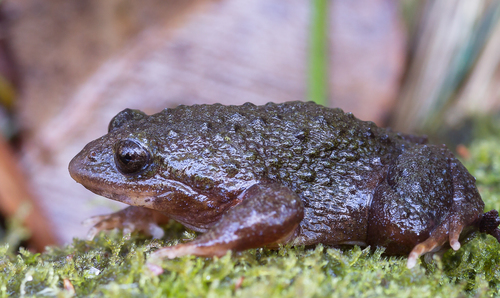
The Sharp Snouted Day Frog (Taudactylus acutirostris) is a small, slender-bodied frog once common in the fast-flowing streams of Australia's Wet Tropics. Adults reach only about 3 centimetres in length, with smooth, mottled grey-brown to olive skin that provides camouflage against wet rocks and leaf litter, and a distinctively pointed snout that gives the species its common name. As a day-active frog, it foraged along stream banks and rocky creek margins in upland rainforest, relying on cool, oxygen-rich water for breeding and larval development.
The species is classified as Critically Endangered (CR) by the IUCN, following one of the most dramatic collapses recorded among Australian amphibians. Historically found across the uplands of northeastern Queensland, from the Carbinda Range south to Townsville, populations vanished with startling speed during the late 1980s and 1990s, coinciding with the spread of chytrid fungus (Batrachochytrium dendrobatidis) through montane rainforest streams. Surveys since the early 2000s have failed to confirm any surviving wild populations, and the species is now considered possibly extinct in the wild, though targeted searches continue in remote, high-altitude refugia where cooler stream temperatures may limit pathogen impact.
On a more encouraging note, the Sharp Snouted Day Frog has become a focal species for chytrid research, and insights gained from studying its decline have directly informed conservation strategies for other stream-dwelling frogs in the Wet Tropics, including captive breeding and disease-resistance research programs. Continued monitoring of remnant highland streams keeps open the possibility, however slim, that a relict population may yet be found.
The overwhelming driver of decline in the Sharp Snouted Day Frog was the rapid spread of chytridiomycosis, a fungal disease that devastated stream-breeding frogs across the Wet Tropics uplands during the late 1980s and 1990s. Because the species depended on cool, fast-flowing rainforest streams, it was especially vulnerable to a pathogen that thrives in such conditions. Localized habitat disturbance from forestry and stream modification compounded pressure on already fragmented populations before the fungal outbreak accelerated its collapse.
Habitat
The species inhabited fast-flowing, rocky rainforest streams in upland areas of northeastern Queensland's Wet Tropics, typically at higher elevations with cool, well-oxygenated water.
Other threatened species in Myobatrachidae


Threatened in Australia
Frequently asked questions
Why is Sharp Snouted Day Frog classified as Critically Endangered?
Where does Sharp Snouted Day Frog live?
What are the main threats to Sharp Snouted Day Frog?
Get weekly conservation intelligence
One short digest a week of the most striking species and country data we ship, plus breaking conservation news paired with our database where it matters.
Free, no spam. One-click unsubscribe in every email.