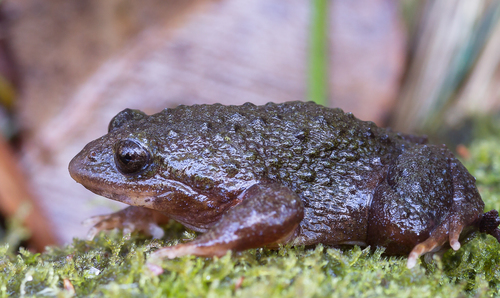
Geocrinia alba
Photo: (c) Kim Williams, all rights reserved, uploaded by Kim Williams
Overview
The White-bellied Frog (Geocrinia alba) is a small terrestrial frog endemic to southwestern Western Australia. This critically endangered species belongs to the family Myobatrachidae and is characterized by its distinctive white ventral coloration that gives it its common name. The species has an extremely restricted distribution, found only in a small area of the Perth Hills region east of Perth.
White-bellied Frogs inhabit granite outcrops and associated vegetation, where they shelter under rocks and in crevices during dry periods. The species exhibits direct development, with eggs laid in moist terrestrial sites and developing directly into small frogs without a free-swimming tadpole stage. This reproductive strategy makes them particularly vulnerable to habitat disturbance and climate variations.
The primary threats to this species include habitat loss and fragmentation due to urban development, quarrying activities, and agricultural expansion in the Perth Hills region. Climate change poses additional risks through altered rainfall patterns and increased temperatures, which can affect the moisture levels critical for their survival and reproduction. The species' extremely limited range makes it highly susceptible to local extinctions from single catastrophic events.
Conservation efforts focus on habitat protection and management of remaining populations, though the species' cryptic nature and small population size present significant challenges for monitoring and conservation planning.
The White-bellied Frog faces severe threats from habitat destruction due to urban development, quarrying, and agriculture in its limited Perth Hills range. Climate change compounds these pressures by altering rainfall patterns and temperature regimes essential for this moisture-dependent species.
Habitat
White-bellied Frogs inhabit granite outcrops and associated vegetation in the Perth Hills region of southwestern Western Australia. They shelter under rocks and in crevices, requiring moist microhabitats for survival and reproduction.
Other threatened species in Myobatrachidae


Frequently asked questions
Why is Geocrinia alba classified as Critically Endangered?
Where does Geocrinia alba live?
What are the main threats to Geocrinia alba?
Get weekly conservation intelligence
One short digest a week of the most striking species and country data we ship, plus breaking conservation news paired with our database where it matters.
Free, no spam. One-click unsubscribe in every email.