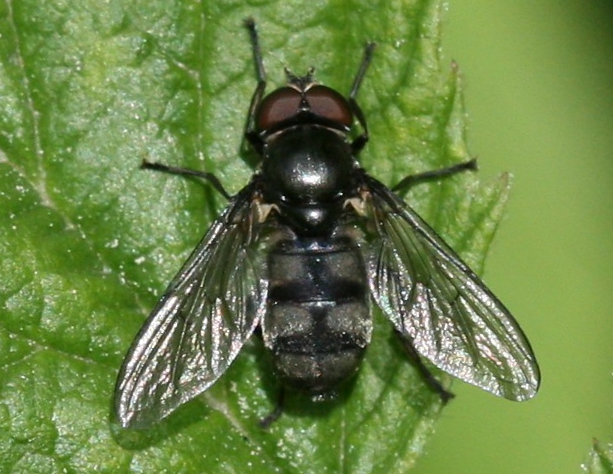
Ramson's Hoverfly
Portevinia maculata
Photo: Wikimedia Commons (CC) via https://en.wikipedia.org/wiki/Portevinia_maculata
Overview
Portevinia maculata is a small hoverfly distinguished by its dark, spotted abdomen and narrow association with a single host plant, wild garlic (ramsons). Adults emerge in spring to coincide with the flowering of this plant, feeding on its nectar and pollen while also using it as a larval host: females lay eggs at the base of the leaves, and larvae develop by mining into the decaying bulbs and rhizomes. This tight ecological link makes the species a specialist rather than a generalist pollinator, and it plays a role in the decomposition of plant material within its woodland habitat as well as in local pollination networks.
The species is found across a broad swath of Europe, including the United Kingdom, Ireland, Norway, Sweden, Denmark, Germany, the Netherlands, Belgium, France, Switzerland, Austria, Czechia, Latvia, and Ukraine, with an isolated record in Australia. It is closely tied to ancient and semi-natural woodland where wild garlic forms dense ground cover, typically in damp, shaded conditions.
Its conservation concern stems from several compounding pressures: deforestation and clearance reduce the extent of suitable woodland, while fragmentation isolates remaining populations from one another. The decline of traditional woodland management, such as coppicing, has altered the structure and light conditions favoring wild garlic stands. Removal of dead wood and general woodland "tidying" eliminates microhabitats the species may depend on, and shifting climate conditions threaten the specific humidity and temperature regimes of its breeding sites.
Targeted conservation measures specific to this species are limited, though it benefits indirectly from broader ancient woodland protection and habitat designation schemes in parts of its range. Population trends remain unknown, making its long-term trajectory difficult to assess with confidence, though ongoing habitat pressures suggest continued vulnerability.
Ramson's Hoverfly is losing its home as ancient woodlands are cut down, broken up into smaller isolated patches, and "tidied up" in ways that remove the rotting wood and leaf litter it depends on to breed. It's also suffering because fewer woodlands are managed using traditional methods that once kept its habitat healthy, while shifting weather patterns are altering the damp, shady conditions it needs to survive. These pressures are ongoing and show no sign of easing, suggesting the threats to this species are stable to intensifying rather than improving.
Habitat
Ramson's Hoverfly inhabits ancient deciduous woodlands, particularly beech and oak forests with abundant dead wood and fallen logs. The species requires specific microhabitats within these forests, including shaded areas with high humidity and decaying wood substrates where larvae can develop.
Other threatened species in Syrphidae


Threatened in Australia
Frequently asked questions
Why is Ramson's Hoverfly classified as Vulnerable?
Where does Ramson's Hoverfly live?
What are the main threats to Ramson's Hoverfly?
Get weekly conservation intelligence
One short digest a week of the most striking species and country data we ship, plus breaking conservation news paired with our database where it matters.
Free, no spam. One-click unsubscribe in every email.