
Northern Corroboree Frog
Pseudophryne pengilleyi
Photo: Wikimedia Commons (CC) via https://en.wikipedia.org/wiki/Northern_corroboree_frog
Overview
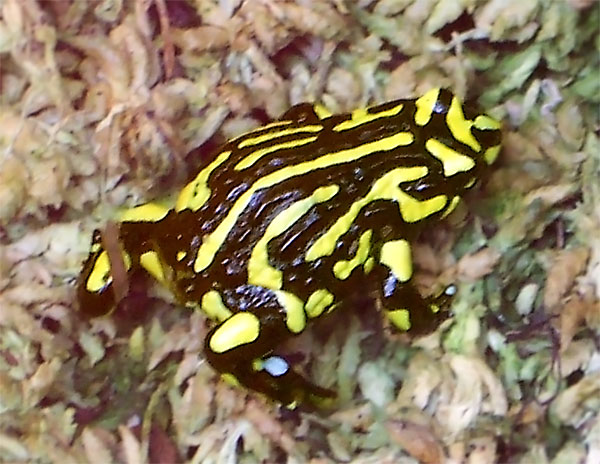
Pseudophryne pengilleyi is a small ground-dwelling frog, rarely exceeding 3 cm in length, distinguished by bright yellow-green and black marbled markings on its back. Males call from concealed positions in low vegetation and moss near breeding sites, and eggs are laid in terrestrial nests rather than directly in water, with larvae developing only after rains flood the nest sites. As insectivores, adults contribute to invertebrate population control within their habitat, and their presence serves as an indicator of wetland and montane ecosystem health.
The species is restricted to the Southern Tablelands and adjacent ranges of New South Wales and the Australian Capital Territory, occupying high-elevation forests, shrublands, grasslands, and associated bogs, fens, and other inland wetlands.
Its decline is driven by chytrid fungus infection, a disease that has devastated montane frog populations across southeastern Australia. Compounding this are habitat degradation from feral horses and other invasive species, altered fire regimes and increasingly severe bushfires, prolonged drought, and shifting temperature and precipitation patterns linked to climate change. Agricultural expansion, residential development, and encroachment by invasive plants further fragment and degrade remaining habitat.
Conservation efforts include captive breeding and reintroduction programs run by Australian zoos and wildlife agencies, disease research targeting chytrid fungus management, habitat protection within reserves, and control of feral horses and invasive weeds in known breeding areas. Monitoring programs track remaining wild populations, which have become small and fragmented.
Despite these interventions, the species remains in continued decline, with wild populations persisting at low numbers across a limited range. Its long-term survival is heavily dependent on sustained captive breeding support and effective disease and habitat management.
The Northern Corroboree Frog is threatened by disease introduced by non-native species (such as chytrid fungus), competition or predation from other native animals, and the loss of habitat due to land being cleared for farming, crops, and housing developments. Climate change is also making things worse by causing more droughts, extreme temperatures, and altered fire patterns that damage the frog's mountain habitat. Overall, these threats appear to be intensifying, particularly due to the compounding effects of climate change and altered fire regimes.
Habitat
This species inhabits open woodlands and grasslands with scattered trees, particularly favoring areas with rocky outcrops and seasonal pools for breeding. It requires specific microhabitats including fallen logs, rock crevices, and dense ground vegetation for shelter and foraging.
Conservation measures underway
Other threatened species in MYOBATRACHIDAE

Threatened in Australia
Frequently asked questions
Why is Northern Corroboree Frog classified as Critically Endangered?
Where does Northern Corroboree Frog live?
What are the main threats to Northern Corroboree Frog?
Get weekly conservation intelligence
One short digest a week of the most striking species and country data we ship, plus breaking conservation news paired with our database where it matters.
Free, no spam. One-click unsubscribe in every email.