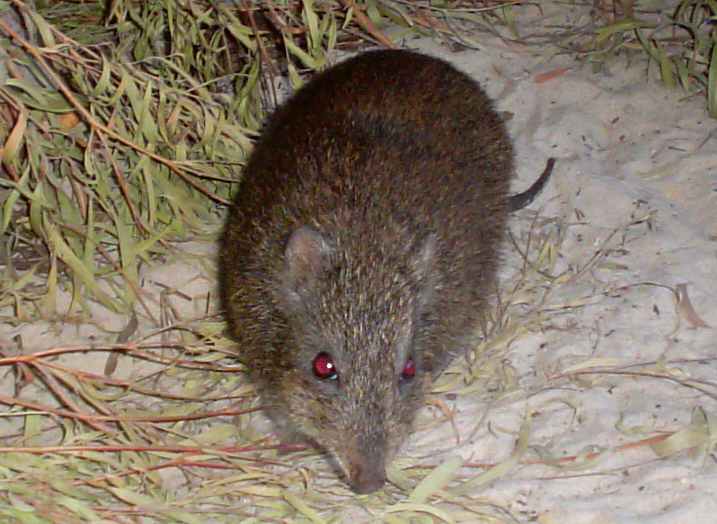
Gilbert's Potoroo
Potorous gilbertii
Photo: Photo: Wikimedia Commons, CC BY-SA
Overview
Potorous gilbertii is a small, nocturnal marsupial in the family Potoroidae, closely related to kangaroos and wallabies. It has a compact body, greyish-brown fur, a pointed snout, and a prehensile tail used for carrying nesting material. Like other potoroos, it is largely mycophagous, feeding on underground fungi as well as roots, seeds, and invertebrates.
By digging for fungi and dispersing spores through its droppings, it plays an important role in maintaining soil health and forest nutrient cycling, forming symbiotic links between fungi and vegetation.
The species is restricted to a very small area of shrubland habitat near Albany in southwestern Australia, particularly the Two Peoples Bay Nature Reserve and a small number of translocated populations on offshore islands and fenced mainland sites. This narrow distribution makes it one of the most range-restricted mammals in Australia.
Its critically endangered status stems from a combination of severe threats: wildfire and inappropriate fire management, which can destroy entire habitat patches given the species' small range; predation by introduced cats and foxes; ongoing habitat fragmentation; and the compounding genetic risks of a small, isolated population. Climate change is expected to further degrade coastal shrubland habitat over time.
Conservation efforts include predator control, fire management planning, captive breeding, and establishment of insurance populations on predator-free islands and fenced reserves to spread extinction risk across multiple sites. Ongoing monitoring tracks population size and genetic diversity.
Despite these interventions, the species remains highly vulnerable due to its extremely limited range and small total population. Its long-term survival depends on continued protection from fire and predators and the success of translocated populations in establishing themselves independently.
Gilbert's Potoroo, a small rabbit-sized marsupial, faces serious danger from bushfires that can wipe out its limited habitat, along with hunting by introduced predators like cats and foxes. Its survival is further threatened by the loss and breaking-up of its coastal habitat, rising sea levels and changing weather patterns linked to climate change, and the fact that so few individuals remain that inbreeding has become a genetic concern. Overall, these threats appear to be ongoing and intensifying, particularly as climate change increases fire risk and coastal habitat pressure.
Habitat
Gilbert's potoroo inhabits dense, low coastal heathland and scrubland in southwestern Western Australia, particularly areas with thick understory vegetation that provides cover and foraging opportunities. The species requires a mosaic of vegetation ages created by carefully managed fire regimes, favoring areas with dense shrub cover for shelter and more open patches for feeding.
Conservation measures underway
Other threatened species in POTOROIDAE

Threatened in Australia
Frequently asked questions
Why is Gilbert's Potoroo classified as Critically Endangered?
Where does Gilbert's Potoroo live?
What are the main threats to Gilbert's Potoroo?
Get weekly conservation intelligence
One short digest a week of the most striking species and country data we ship, plus breaking conservation news paired with our database where it matters.
Free, no spam. One-click unsubscribe in every email.