Cardinal Click Beetle
Ampedus cardinalis
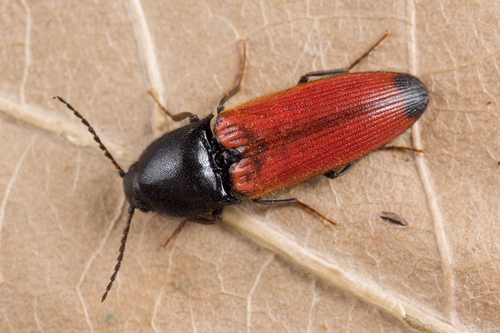
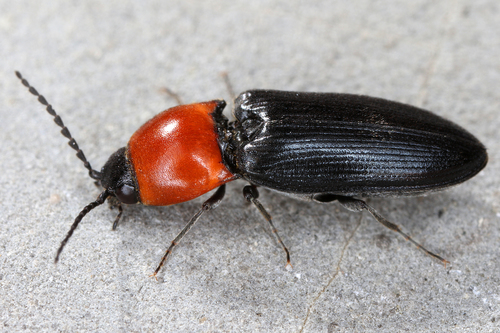
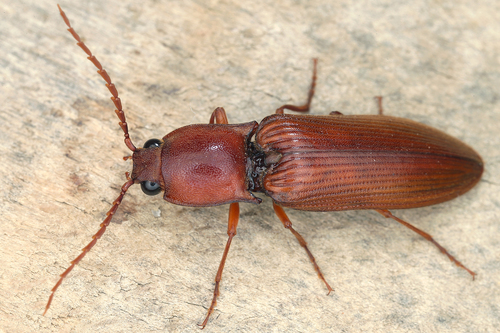
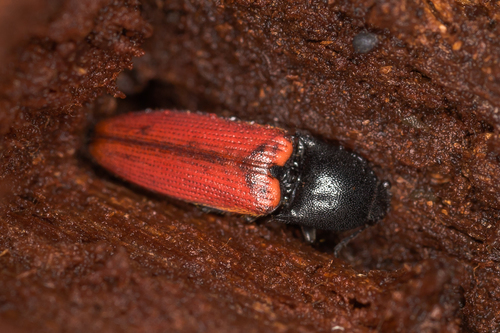
The Cardinal Click Beetle (Ampedus cardinalis) is a striking red-colored click beetle distinguished by its vibrant cardinal-red elytra and robust body structure. This species plays a crucial ecological role as both predator and decomposer, with larvae feeding on wood-boring insects within decaying hardwood trees while adults contribute to nutrient cycling in forest ecosystems.
14
Countries
Photo: iNaturalist: (c) Shamil Murtazin, some rights reserved (CC BY-NC), uploaded by Shamil Murtazin
Taxonomy & Classification
Kingdom
Animalia
Phylum
Arthropoda
Class
Insecta
Order
Coleoptera
Family
Elateridae
Genus
Ampedus
Cardinal Click Beetle belongs to the family Elateridae, order Coleoptera, within the Insecta class.
Species Profile
The Cardinal Click Beetle (Ampedus cardinalis) is a striking red-colored click beetle distinguished by its vibrant cardinal-red elytra and robust body structure. This species plays a crucial ecological role as both predator and decomposer, with larvae feeding on wood-boring insects within decaying hardwood trees while adults contribute to nutrient cycling in forest ecosystems.
The Cardinal Click Beetle faces severe population decline primarily due to habitat loss from deforestation and land conversion in its limited range. As a saproxylic species dependent on decaying wood in old-growth forests, it is particularly vulnerable to logging activities and forest fragmentation that eliminate the dead and dying trees essential for its larval development.
Key Facts
Habitat & Distribution
Cardinal Click Beetles inhabit mature deciduous and mixed forests, specifically requiring large diameter dead or dying oak, maple, and beech trees for reproduction and larval development. Adults are typically found in forest canopies and on decaying wood surfaces in old-growth forest remnants with substantial coarse woody debris.
Threats
IUCN Red List: Critically Endangered
The Cardinal Click Beetle faces severe population decline primarily due to habitat loss from deforestation and land conversion in its limited range. As a saproxylic species dependent on decaying wood in old-growth forests, it is particularly vulnerable to logging activities and forest fragmentation that eliminate the dead and dying trees essential for its larval development.
Habitat loss and deforestation
Loss of old-growth forest ecosystems
Removal of dead wood and forest management practices
Climate change impacts on forest composition
Forest fragmentation
Found in 14 Countries
National vs Global Threat Status
How this species is assessed at the national level compared to its IUCN global status (CR).
| Country | National Status | Global Status | Comparison |
|---|---|---|---|
| EU | NTNear Threatened | CRCritically Endangered | Lower local risk |
| EU | NTNear Threatened | CRCritically Endangered | Lower local risk |
National Red List data sourced from the National Red List Project (nationalredlist.org, ZSL) and country-specific Red List authorities.
Community Sightings
Report a sightingNo community sightings yet. Be the first to report!
Sources & Attribution
How to Cite
IUCN: IUCN (2025). The IUCN Red List of Threatened Species. Version 2025-1. Available at: https://www.iucnredlist.org. doi:10.2305/IUCN.UK.2025-1.RLTS
GBIF: GBIF.org (2025). GBIF Home Page. Available at: https://www.gbif.org
National Red Lists: ZSL (2025). National Red List. Zoological Society of London. Available at: https://www.nationalredlist.org
This page: SpeciesRadar (2025). Cardinal Click Beetle (Ampedus cardinalis). SpeciesRadar: Intelligence for Earth's Biodiversity. Available at: https://speciesradar.org/species/cardinal-click-beetle