
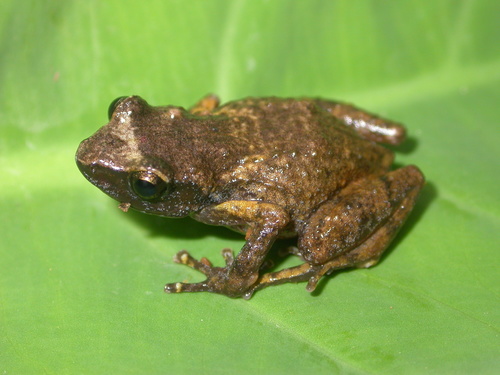
Baracoa Dwarf Frog
Eleutherodactylus orientalis
Photo: Photo: Wikimedia Commons, CC BY-SA
Overview
The Baracoa Dwarf Frog is a small terrestrial amphibian endemic to Cuba's easternmost region. This diminutive species belongs to the diverse genus Eleutherodactylus, characterized by direct development—eggs hatch directly into miniature frogs without a tadpole stage. Like other members of its genus, it likely feeds on small invertebrates and plays a role in controlling insect populations within its ecosystem.
This critically endangered species has an extremely restricted range, found only in the Baracoa region of Guantánamo Province in eastern Cuba. The frog inhabits montane forests in this biodiverse area, which forms part of the Cuban endemic hotspot. Its precise habitat requirements and elevational range remain poorly documented due to limited field research.
The primary threat to E. orientalis is habitat loss through deforestation and agricultural conversion in its limited range. The species' restriction to a small geographic area makes it particularly vulnerable to localized environmental changes. Climate change may pose additional risks through altered precipitation patterns and temperature regimes affecting its forest habitat.
Currently, no specific conservation programs target this species directly. Its habitat falls within Cuba's protected area system, though enforcement and management effectiveness vary. The species requires urgent taxonomic and ecological research to better understand its population status and specific conservation needs.
With its critically endangered status and unknown population trend, the Baracoa Dwarf Frog faces an uncertain future. The lack of recent population data and ongoing habitat pressures suggest continued decline risk without immediate conservation intervention.
Based on the available data, the specific threats facing the Baracoa Dwarf Frog have not yet been formally assessed or documented by researchers. Without this threat assessment, it's not possible to identify what particular dangers this species may be facing in its natural habitat. The current status of whether threats are increasing, stable, or decreasing cannot be determined until a proper threat evaluation is completed.
Conservation measures underway
Other threatened species in ELEUTHERODACTYLIDAE

Threatened in Cuba
Frequently asked questions
Why is Baracoa Dwarf Frog classified as Critically Endangered?
Where does Baracoa Dwarf Frog live?
What are the main threats to Baracoa Dwarf Frog?
Get weekly conservation intelligence
One short digest a week of the most striking species and country data we ship, plus breaking conservation news paired with our database where it matters.
Free, no spam. One-click unsubscribe in every email.