Acipenser schrenckii
CR

Acipenser schrenckii

Declining

Photo: Wikimedia Commons (CC) via https://en.wikipedia.org/wiki/Amur_sturgeon

Overview

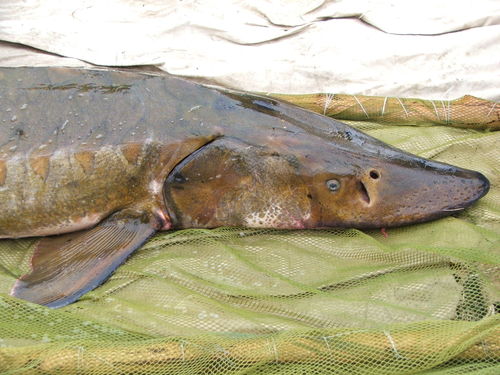
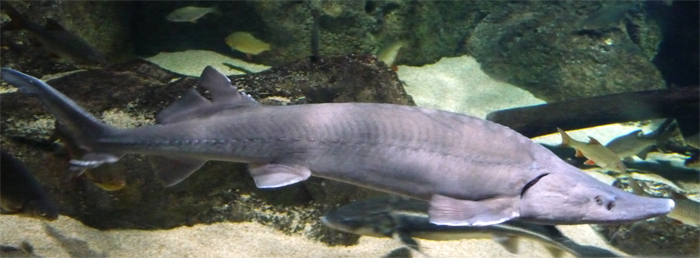
Acipenser schrenckii, commonly known as the Amur sturgeon, is a large anadromous fish species native to the Amur River basin and adjacent coastal waters of the Sea of Okhotsk and Sea of Japan. This impressive sturgeon can reach lengths of up to 2 meters and weights exceeding 100 kilograms, characterized by its elongated body, distinctive rows of bony scutes, and barbels near the mouth used for bottom feeding. The species exhibits a dark gray to brownish coloration on its dorsal surface with a lighter ventral side.

Amur sturgeon are slow-growing, long-lived fish that can survive for several decades, reaching sexual maturity between 9-16 years of age. They undertake extensive migrations between marine feeding areas and freshwater spawning grounds in the Amur River system, primarily spawning in the middle and upper reaches of the river during late spring and early summer. The species feeds on benthic invertebrates, small fish, and crustaceans using their sensitive barbels to locate prey in murky river bottoms.

Currently classified as Critically Endangered by the IUCN, Acipenser schrenckii has experienced severe population declines over the past several decades due to multiple anthropogenic pressures. The species' distribution spans Russia, China, and Mongolia, with the majority of remaining populations concentrated in Russian waters. Encouragingly, recent collaborative conservation efforts between Russia and China have established joint monitoring programs and artificial breeding initiatives that show promise for population recovery, with several hatcheries now successfully producing juvenile sturgeon for release programs.

The Amur sturgeon faces severe threats from overfishing and illegal harvesting driven by the high commercial value of its roe for caviar production, which has decimated wild populations across its range. Large-scale dam construction along the Amur River system has fragmented critical spawning habitats and blocked traditional migration routes, preventing adults from reaching upstream breeding areas. Industrial pollution and agricultural runoff have degraded water quality in both marine and freshwater habitats, while sand mining operations have destroyed essential spawning substrates in river channels.

Threat summary

Habitat

Acipenser schrenckii inhabits the Amur River basin and adjacent marine waters of the northwestern Pacific, including the Sea of Okhotsk and northern Sea of Japan. The species requires both freshwater river systems for spawning and brackish to marine coastal waters for feeding and growth, typically preferring areas with rocky or gravel substrates and strong currents.

Wetlands (inland) - Permanent rivers/streams· major

Conservation measures underway

Legislation