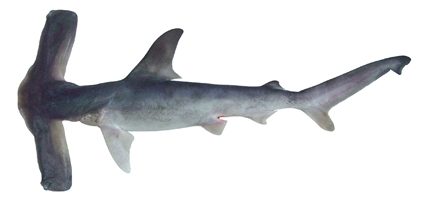
Winghead Shark
Eusphyra blochii
Photo: Wikimedia Commons (CC) via https://en.wikipedia.org/wiki/Winghead_shark
Overview
The winghead shark is a distinctive member of the hammerhead family, easily recognized by its extremely wide, wing-like cephalofoil, which can extend nearly half the length of its body. This structure enhances maneuverability and improves detection of prey, such as small bony fish, shrimp, and cephalopods, using electroreceptors distributed across its expanded head. Reaching around 1.5 to 1.9 meters in length, this species is a fast-swimming, active predator that plays a role in regulating prey populations in nearshore food webs.
It is viviparous, giving birth to live young after a gestation period, with relatively small litter sizes that limit its capacity for rapid population recovery.
This shark inhabits shallow coastal and inshore waters, including estuaries, river mouths, and continental shelves, across a broad range spanning the Indo-West Pacific and extending into parts of the Middle East and South Asia. It has been recorded in countries including Australia, India, Indonesia, Pakistan, Thailand, and many others bordering the Indian Ocean and western Pacific.
Its decline is driven by intense fishing pressure throughout its shallow-water range, including targeted capture for the shark fin trade and incidental bycatch in gillnet and trawl fisheries. Coastal habitat degradation from aquaculture expansion, dredging, urban development, and agricultural runoff further reduces available nursery and feeding grounds. Its low reproductive output compounds these pressures, slowing any potential recovery.
Conservation efforts include regional fisheries management measures, bycatch reduction initiatives, and international trade regulation under CITES. However, enforcement remains inconsistent across much of its range. Given ongoing habitat loss and fishing mortality, the species' population trend continues to decline, and its long-term outlook remains precarious without stronger, range-wide protective measures.
The Winghead Shark is mainly threatened by getting caught in fishing nets and trawls, both as a target catch and as accidental bycatch, with its fins often sold into the shark fin trade. Its coastal habitats are also being damaged by activities like shrimp/fish farming, sand and mineral mining, dam construction, coastal urban development, and farmland expansion near shorelines. Because this species reproduces slowly, it cannot easily recover from these combined pressures, and since all these threats remain active and ongoing, the overall risk to the species appears to be intensifying.
Habitat
Winghead sharks inhabit shallow coastal waters, estuaries, and continental shelf areas throughout the tropical Indo-Pacific, typically found at depths of 5-40 meters. They prefer muddy or sandy bottoms near river mouths and mangrove systems, which serve as critical nursery habitats for juveniles.
Conservation measures underway
Other threatened species in SPHYRNIDAE

Threatened in Australia
Frequently asked questions
Why is Winghead Shark classified as Critically Endangered?
Where does Winghead Shark live?
What are the main threats to Winghead Shark?
Get weekly conservation intelligence
One short digest a week of the most striking species and country data we ship, plus breaking conservation news paired with our database where it matters.
Free, no spam. One-click unsubscribe in every email.