Smooth Hammerhead
Sphyrna zygaena
Overview
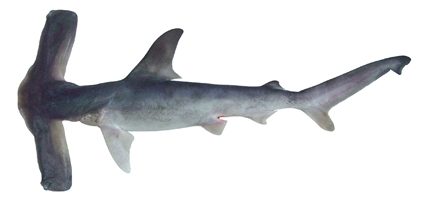
Sphyrna zygaena is a large migratory shark distinguished by its flattened, mallet-shaped head, or cephalofoil, which enhances sensory detection and maneuverability while hunting. Unlike some relatives, its head margin is smoothly rounded rather than notched, giving rise to its common name. It feeds on bony fishes, cephalopods, and other elasmobranchs, including stingrays, and as a mobile predator helps regulate prey populations and maintain balance within marine food webs.
Individuals can travel long distances, sometimes forming large schools, particularly females during migration.
The species has a near-cosmopolitan distribution in temperate and tropical waters, occupying both oceanic and coastal habitats. It has been recorded across an extensive range of coastal nations spanning the Atlantic, Pacific, and Indian Oceans, from continental shelves to open ocean environments, often near the surface but capable of deeper excursions.
Its primary threat is targeted and incidental capture in commercial and artisanal fisheries, driven by demand for fins and, to a lesser extent, meat. Because of its schooling behavior and coastal-to-oceanic movements, it is highly vulnerable to longline and gillnet fisheries operating across its range, and bycatch in tuna and swordfish fisheries is common. Slow reproductive rates limit the species' ability to recover from sustained fishing pressure.
Conservation measures include listing under CITES Appendix II, which regulates international trade in fins and other products, along with regional fishing restrictions and shark sanctuaries established by some coastal states. Enforcement and monitoring remain inconsistent across its wide range.
Population trends are declining, and the species is classified as Vulnerable. Without stronger enforcement of trade and fisheries regulations across international waters, continued population reduction is likely.
Smooth Hammerheads are mainly threatened by fishing, being caught both on purpose for their fins and meat and accidentally as bycatch in nets and longlines set for other species. This ongoing pressure from commercial and artisanal fisheries across their ocean range makes it hard for populations to recover, since these sharks reproduce slowly. This threat is ongoing and shows no signs of easing.
Habitat
Conservation measures underway
Other threatened species in SPHYRNIDAE

Threatened in Algeria



Frequently asked questions
Why is Smooth Hammerhead classified as Vulnerable?
Where does Smooth Hammerhead live?
What are the main threats to Smooth Hammerhead?
Get weekly conservation intelligence
One short digest a week of the most striking species and country data we ship, plus breaking conservation news paired with our database where it matters.
Free, no spam. One-click unsubscribe in every email.