Westralunio carteri
Local name: Carter’s Freshwater Mussel
Overview
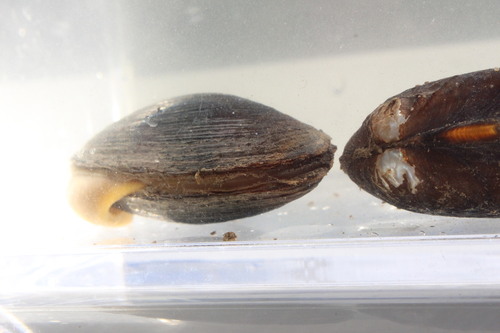
Westralunio carteri is a freshwater bivalve mollusc endemic to southwestern Australia, belonging to the family Hyriidae. It has an elongated, oval shell typically dark brown to black in colour, growing to around 10 centimetres in length. Like other unionid mussels, it is a filter feeder, drawing water through its gills to extract algae, bacteria, and organic particles, a process that helps maintain water clarity and quality.
Its larvae, known as glochidia, undergo a brief parasitic stage attached to the gills or fins of host fish before dropping off to settle as free-living juveniles, a life cycle that links the mussel's survival to the presence of suitable fish populations.
The species occurs in permanent rivers and streams across the southwest of Western Australia, favouring stable, well-oxygenated freshwater habitats with sandy or gravelly substrates.
Populations are declining due to a combination of pressures. Urban expansion and associated infrastructure have altered and fragmented waterways, while land clearing for livestock grazing and logging has increased sedimentation and degraded riparian vegetation. Dams and water extraction have reduced flow and connectivity, and agricultural runoff has introduced nutrients and contaminants.
Invasive species and unspecified pollution sources add further stress, and incidental harvesting also affects local populations.
Conservation efforts include monitoring of remaining populations, research into habitat requirements and host-fish relationships, and consideration of water allocation policies in river management planning. Some catchments have been prioritised for habitat protection and rehabilitation.
Given ongoing habitat modification and water resource pressures across its restricted range, the species' population trend remains downward, and its long-term outlook depends on effective river management and habitat restoration in southwestern Australia.
Carter's Freshwater Mussel faces ongoing pressure from urban development, farming, and logging near waterways, which can degrade the rivers and streams it depends on. Dam construction and water management alter natural water flow, while runoff from farms and forestry operations, along with other forms of pollution, contaminate its habitat; competition from invasive species and harvesting also add to the strain. Based on the ongoing nature of all these threats, the overall pressure on this species appears to be stable to intensifying rather than decreasing.
Habitat
Conservation measures underway
Other threatened species in HYRIIDAE
Threatened in Australia
Frequently asked questions
Why is Carter’s Freshwater Mussel classified as Vulnerable?
Where does Carter’s Freshwater Mussel live?
What are the main threats to Carter’s Freshwater Mussel?
Get weekly conservation intelligence
One short digest a week of the most striking species and country data we ship, plus breaking conservation news paired with our database where it matters.
Free, no spam. One-click unsubscribe in every email.