Anakelisia fasciata
Overview
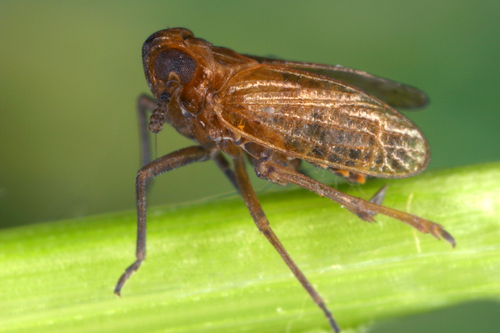
Anakelisia fasciata is a small planthopper in the family Delphacidae, a group of sap-feeding insects within the order Hemiptera. Like other delphacids, it likely feeds on the phloem of sedges or grasses using piercing-sucking mouthparts, and probably exhibits wing-form variation (long- and short-winged individuals) common to the genus, which influences dispersal ability. Such planthoppers typically play a modest but consistent role in wetland food webs, serving as prey for spiders, predatory insects, and birds, while their feeding can influence the vigor of host plant stands.
The species has a broad range across Europe, extending from the United Kingdom and Ireland through Scandinavia, continental Europe, the Balkans, and into Russia and Azerbaijan, with an additional occurrence noted in Australia. It is associated with terrestrial habitats linked to wetland margins, where its host plants grow.
Population trends are currently unknown, but the species is classified as Vulnerable due to a combination of ongoing pressures. Wetland drainage and conversion for agriculture or development have reduced suitable habitat, while agricultural intensification and associated pesticide use degrade remaining sites. Runoff pollution from farmland affects water and soil quality in wetland margins, and shifting precipitation patterns linked to climate change threaten the hydrological stability these habitats depend on.
Fragmentation has further isolated populations, limiting gene flow and recolonization after local declines.
Conservation measures specific to this species are not well documented, though it may benefit indirectly from wetland protection policies and agri-environment schemes across its European range. Continued habitat loss and fragmentation suggest a cautious outlook, with long-term persistence dependent on wetland conservation and reduced agricultural pressure across its range.
Anakelisia fasciata is mainly threatened by the draining and conversion of its wetland habitat, along with pollution and chemical runoff from nearby farming activity. Increasingly intense farming practices are also breaking up its habitat into smaller, disconnected patches, while shifting rainfall patterns linked to climate change add further pressure. These combined threats appear to be ongoing and intensifying rather than stabilizing or improving.
Habitat
This specialized planthopper inhabits wetland margins and sedge-dominated communities, particularly areas with Carex species along riverbanks, lake shores, and marshy grasslands. The species requires specific moisture conditions and is closely associated with its sedge host plants in these transitional wetland ecosystems.
Other threatened species in Delphacidae
Threatened in Australia
Frequently asked questions
Why is Anakelisia fasciata classified as Vulnerable?
Where does Anakelisia fasciata live?
What are the main threats to Anakelisia fasciata?
Get weekly conservation intelligence
One short digest a week of the most striking species and country data we ship, plus breaking conservation news paired with our database where it matters.
Free, no spam. One-click unsubscribe in every email.