
Red Handfish
Thymichthys politus
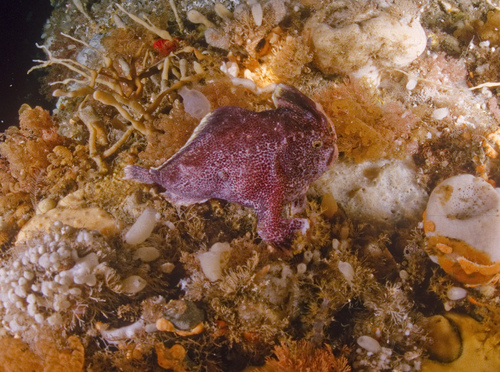
Photo: Photo: Wikimedia Commons, CC BY-SA
Overview
Thymichthys politus is a small, bottom-dwelling anglerfish distinguished by its modified pectoral fins, which function as limb-like structures for "walking" across the seafloor rather than swimming. Reaching only around 6-10 centimetres in length, this cryptic species relies on camouflage and a lure-like dorsal appendage to ambush small invertebrate and crustacean prey. It exhibits strong site fidelity, spending most of its life within a very limited home range, and lays benthic egg masses that it may guard until hatching.
As an ambush predator, it plays a niche role in regulating small invertebrate populations within its habitat.
The species is restricted to a small number of reef sites in southeastern Tasmania, Australia, occupying shallow marine neritic and oceanic waters typically associated with macroalgae-covered rocky reefs and adjacent sandy or silty substrates.
Its extreme rarity and restricted range make it acutely vulnerable to localised disturbance. Coastal urban development, agricultural and forestry runoff, and effluent discharge degrade water quality and smother reef habitat with sediment. Invasive species, including the introduced sea urchin, have contributed to habitat alteration by overgrazing kelp and reef algae the fish depends on for shelter and camouflage.
Broader habitat shifts linked to warming waters have further reduced suitable reef structure.
Conservation efforts include intensive population monitoring by Australian researchers and agencies, captive breeding and rearing programs, and the installation of artificial reef habitat structures at known sites to offset degraded natural habitat. Legal protections exist under Australian environmental legislation.
With only a handful of known wild subpopulations and continuing habitat pressure, the species' outlook remains precarious, and its population trend is assessed as decreasing.
The Red Handfish is mainly threatened by pollution and runoff from nearby towns, farms, and forestry operations washing into its coastal waters, along with invasive species that compete with or disturb its habitat. Its environment is also being altered by shifting coastal conditions, likely linked to warming seas and changing underwater habitats like kelp beds. These combined pressures appear to be ongoing and stable rather than clearly increasing or decreasing at this time.
Habitat
Conservation measures underway
Other threatened species in BRACHIONICHTHYIDAE
Threatened in Australia
Frequently asked questions
Why is Red Handfish classified as Critically Endangered?
Where does Red Handfish live?
What are the main threats to Red Handfish?
Get weekly conservation intelligence
One short digest a week of the most striking species and country data we ship, plus breaking conservation news paired with our database where it matters.
Free, no spam. One-click unsubscribe in every email.