Narrowbody Handfish
Pezichthys compressus
Overview
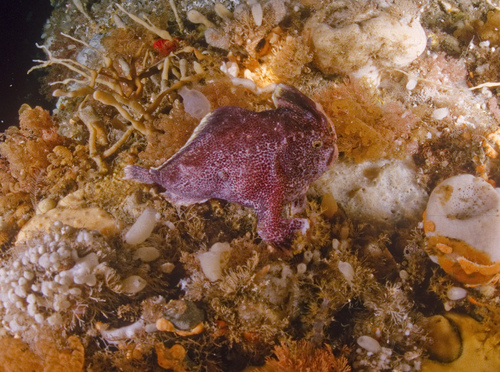
Pezichthys compressus is a small, bottom-dwelling anglerfish belonging to the handfish family, distinguished by its laterally compressed body and modified pectoral fins that function as limb-like appendages for "walking" across the seafloor rather than swimming. Like other handfishes, it is a slow-moving, sedentary ambush predator, using a small lure derived from its dorsal fin spine to attract invertebrate and small fish prey. Its poor dispersal ability and reliance on specific substrate make it highly sensitive to habitat disturbance, and as a benthic predator it plays a role in regulating small invertebrate populations within its local marine community.
The species is restricted to marine waters off Australia, inhabiting oceanic and coastal seafloor habitats. Handfishes generally occupy narrow depth ranges and show strong site fidelity, rarely moving far from suitable substrate, which limits their capacity to recolonize areas after local declines.
Population trends are decreasing, driven by multiple ongoing pressures. Fishing and harvesting activities, including bycatch in benthic trawl and net fisheries, directly reduce numbers and damage seafloor habitat. Invasive species, including predatory or habitat-altering marine organisms, compete with or prey upon it.
Unrecorded or poorly characterized pollution sources degrade water quality and benthic conditions, while land-based logging and wood harvesting contribute to sediment runoff that can smother seafloor habitat.
Conservation efforts for Australian handfishes generally include habitat protection measures, marine park zoning, monitoring surveys, and research into captive breeding and habitat restoration led by government and research institutions. Specific programs targeting this species are limited given its restricted range and low visibility.
Given continuing habitat degradation and multiple concurrent threats, the species' outlook remains poor, with population decline expected to continue absent stronger targeted intervention.
The Narrowbody Handfish faces ongoing pressure from fishing activities that can accidentally catch or harm it, along with invasive species and diseases that compete with or prey on it. It also suffers from unspecified pollution affecting its habitat, as well as impacts from logging and wood harvesting activities in surrounding areas. All of these threats are currently classified as ongoing, suggesting a stable but persistent level of risk rather than a clear increase or decrease.
Habitat
Conservation measures underway
Other threatened species in BRACHIONICHTHYIDAE

Threatened in Australia
Frequently asked questions
Why is Narrowbody Handfish classified as Endangered?
Where does Narrowbody Handfish live?
What are the main threats to Narrowbody Handfish?
Get weekly conservation intelligence
One short digest a week of the most striking species and country data we ship, plus breaking conservation news paired with our database where it matters.
Free, no spam. One-click unsubscribe in every email.