Pink Handfish
Brachiopsilus dianthus
Overview
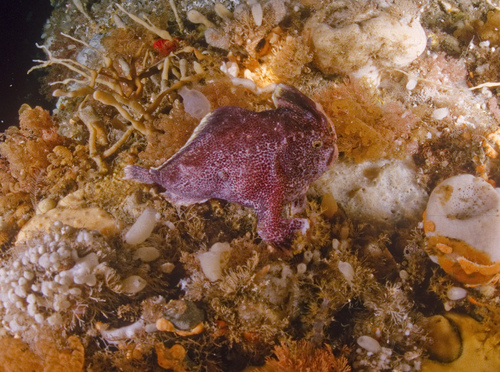
This small anglerfish is distinguished by its highly modified pectoral fins, which have evolved into limb-like structures used to "walk" along the seafloor rather than swim in open water. Reaching only a few centimetres in length, it displays pink to reddish coloration and, like other handfish, possesses a lure (illicium) used to attract small invertebrate and crustacean prey. Its mobility is limited, and it is thought to spend most of its life within a very restricted home range, making it a poor disperser and highly sensitive to localized habitat disturbance.
The species is known only from waters off Tasmania, Australia, where it inhabits rocky reef and sponge-dominated marine habitats at moderate depths. Sightings have historically been rare, and its overall range is thought to be extremely limited.
Its decline is driven by a combination of pressures: incidental capture and disturbance from fishing activity, degradation of seafloor habitat from other human ecosystem modifications, spread of invasive marine species such as the northern Pacific seastar, unspecified pollution affecting coastal waters, and habitat alteration linked to coastal logging and runoff. Because the species has such limited mobility and a narrow habitat niche, even localized disturbances can have outsized effects on its population.
Conservation efforts include targeted surveys by Australian marine researchers to better understand its distribution and abundance, habitat protection measures within Tasmanian marine reserves, and its inclusion in broader handfish conservation and monitoring programs alongside related threatened species. Captive breeding and habitat restoration initiatives developed for other handfish species may offer transferable conservation approaches.
Given its restricted range, low detection rates, and ongoing habitat pressures, the species' population is assessed as decreasing, and its long-term outlook remains uncertain without sustained monitoring and habitat protection.
The Pink Handfish faces ongoing pressure from fishing activities that can accidentally catch or disturb it, along with changes to its seafloor habitat caused by human activity and nearby logging operations that increase runoff and sediment into the water. It's also threatened by invasive species competing for space or resources, as well as pollution whose exact source isn't well documented. All of these threats are currently classed as ongoing, suggesting a stable but persistent level of risk rather than a clear increase or decrease.
Habitat
Conservation measures underway
Other threatened species in BRACHIONICHTHYIDAE

Threatened in Australia
Frequently asked questions
Why is Pink Handfish classified as Endangered?
Where does Pink Handfish live?
What are the main threats to Pink Handfish?
Get weekly conservation intelligence
One short digest a week of the most striking species and country data we ship, plus breaking conservation news paired with our database where it matters.
Free, no spam. One-click unsubscribe in every email.