Sympterichthys moultoni
Local name: Moulton’s Handfish
Overview
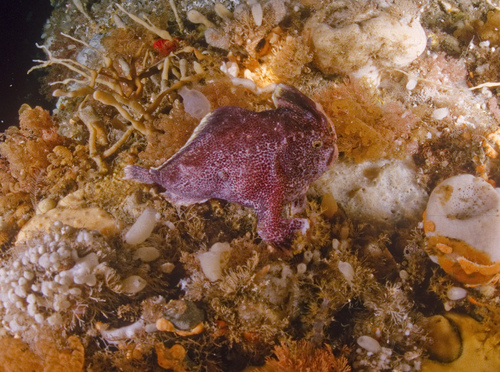
Sympterichthys moultoni is a small, bottom-dwelling anglerfish characterised by fleshy, limb-like pectoral and pelvic fins that it uses to "walk" across the seafloor rather than swim. Like other handfishes, it possesses a lure-like structure (illicium) on its head used to attract small invertebrate and fish prey. It is a slow-moving, sedentary ambush predator with strong site fidelity, meaning individuals tend to remain within a small home range for extended periods.
As a benthic predator, it contributes to regulating small invertebrate and fish populations within its localized habitat.
The species is restricted to marine oceanic waters off Australia, occupying discrete patches of temperate reef and sediment habitat. Its known range is highly limited, and like other handfishes it does not disperse over long distances, leaving populations vulnerable to localized disturbance.
Threats include incidental capture and habitat disturbance associated with fishing and harvesting of aquatic resources, degradation from invasive species (including predatory or habitat-altering marine organisms), unspecified pollution impacts, and habitat alteration linked to coastal logging and wood harvesting activities that affect runoff and sediment quality in adjacent marine environments. Because handfishes have small, fragmented distributions and low mobility, even localized pressures can have outsized population effects.
Conservation efforts for Australian handfish species generally include monitoring programs, habitat protection within marine reserves, captive breeding research, and initiatives to reduce sediment and pollutant runoff into coastal waters. Population trend data classify the species as decreasing.
Given its restricted range, low dispersal capacity, and multiple ongoing anthropogenic pressures, the species' conservation outlook remains precarious, with continued monitoring and habitat protection considered essential to preventing further decline.
Moulton's Handfish faces ongoing pressure from fishing activities that can accidentally catch or disturb it, along with competition or habitat damage caused by invasive species. It is also affected by unspecified pollution entering its marine habitat and by the effects of logging operations on land, which can degrade coastal waters through runoff. All of these threats are currently classified as ongoing, suggesting a stable but persistent level of risk rather than a clear increase or decrease.
Habitat
Conservation measures underway
Other threatened species in BRACHIONICHTHYIDAE
Threatened in Australia
Frequently asked questions
Why is Moulton’s Handfish classified as Endangered?
Where does Moulton’s Handfish live?
What are the main threats to Moulton’s Handfish?
Get weekly conservation intelligence
One short digest a week of the most striking species and country data we ship, plus breaking conservation news paired with our database where it matters.
Free, no spam. One-click unsubscribe in every email.