
Spotted Handfish
Brachionichthys hirsutus
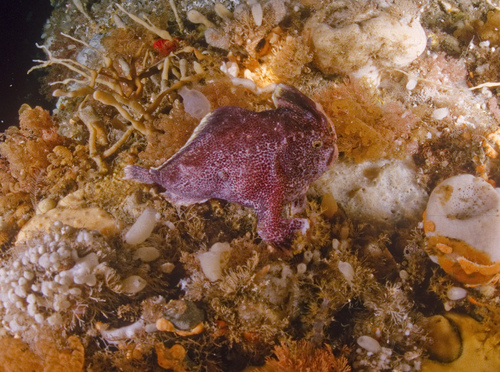
Photo: Wikimedia Commons (CC) via https://en.wikipedia.org/wiki/Spotted_handfish
Overview
Brachionichthys hirsutus is a small bottom-dwelling anglerfish rarely exceeding 12 centimetres in length, distinguished by its hand-like pectoral fins, which it uses to "walk" across the seafloor rather than swim. Its skin bears fine spots and hair-like dermal spinules, giving rise to its common name. As a lie-in-wait predator, it forages for small crustaceans and worms and lays demersal egg clusters that it attaches to seagrass blades, sponges, or other substrates, a reproductive strategy that limits dispersal and confines populations to very small home ranges.
The species is endemic to Tasmania, Australia, occurring in shallow marine coastal and estuarine waters, particularly around the Derwent Estuary and adjacent bays. Its habitat spans soft sediment, seagrass, and sponge-dominated seafloor within the marine neritic and coastal zone.
Its decline stems from cumulative pressures on the Derwent Estuary and nearby coastal habitats: urban and industrial development, wastewater and industrial effluent discharge, agricultural runoff, and general pollution have degraded water and sediment quality. The introduced Northern Pacific seastar (Asterias amurensis) preys on the handfish's egg masses, compounding recruitment failure. Habitat alteration from coastal development has further reduced suitable spawning substrate.
Conservation efforts include a captive breeding and research program led by Australian marine science institutions, deployment of artificial spawning habitats to replace lost natural substrate, ongoing population monitoring, and control measures targeting the invasive seastar. The species is legally protected under Australian environmental legislation.
Population numbers remain extremely low, with surveys indicating only a small number of individuals across a fragmented range. Despite active intervention, the population trend remains decreasing, and the species continues to face a high risk of extinction without sustained habitat restoration and threat mitigation.
The Spotted Handfish faces ongoing pressure from coastal city growth and development near its habitat, along with pollution from household sewage, industrial waste, and farm runoff draining into its waters. It is also threatened by invasive species that compete with or disturb it, as well as changes to the seafloor habitat it depends on for laying eggs and finding shelter. These threats appear to be persistent and continuing rather than easing, suggesting a stable but ongoing level of risk to the species.
Habitat
Conservation measures underway
Other threatened species in BRACHIONICHTHYIDAE
Threatened in Australia
Frequently asked questions
Why is Spotted Handfish classified as Critically Endangered?
Where does Spotted Handfish live?
What are the main threats to Spotted Handfish?
Get weekly conservation intelligence
One short digest a week of the most striking species and country data we ship, plus breaking conservation news paired with our database where it matters.
Free, no spam. One-click unsubscribe in every email.