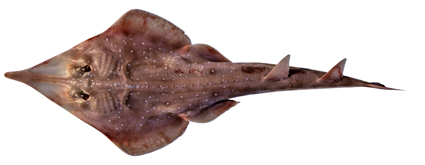
Zapteryx xyster
VU

Zapteryx xyster

Declining

Photo: Wikimedia Commons (CC) via https://en.wikipedia.org/wiki/Southern_banded_guitarfish

Overview

Zapteryx xyster, commonly known as the banded guitarfish, is a cartilaginous fish belonging to the family Trygonorrhinidae, a group of rays with a shark-like body plan combining a flattened head and pectoral disc with a robust, thresher-like tail. Its body is typically marked with faint transverse banding, and its guitar-shaped outline allows it to move efficiently over sandy and muddy substrates while remaining camouflaged from predators and prey alike. As a benthic predator, it feeds on small invertebrates and fish, using an ampullae-of-Lorenzini sensory system to detect prey buried in sediment.

Ecologically, it plays a role in regulating benthic invertebrate populations within coastal marine food webs.

This species inhabits marine coastal waters, generally over soft sandy or muddy bottoms in shallow shelf habitats. Its known geographic range spans the eastern Pacific and parts of the wider region, with confirmed occurrence in Mexico, Panama, Costa Rica, Colombia, Ecuador, and Peru, as well as records from Australia.

The primary threat to Zapteryx xyster is ongoing fishing and harvesting pressure. As a bottom-dwelling species in shallow coastal zones, it is highly vulnerable to incidental capture in artisanal and commercial fisheries, including trawl and gillnet operations targeting other species. Its life history traits, typical of rays, including slow growth and limited reproductive output, constrain its capacity to recover from sustained exploitation.

Conservation measures specific to this species remain limited, though it benefits indirectly from broader elasmobranch fisheries management and marine protected areas within parts of its range. The species is currently classified as Vulnerable, with a decreasing population trend. Without stronger fisheries controls, continued decline is the likely trajectory.

Zapteryx xyster, commonly known as the banded guitarfish, is primarily threatened by ongoing fishing activity, where it is caught either intentionally as a target species or accidentally as bycatch in nets and other fishing gear. This kind of harvesting from the water can reduce population numbers over time, especially for species that reproduce slowly. Based on the available information, this threat appears to be continuous and ongoing rather than clearly increasing or decreasing.

Threat summary

Habitat

MARINE· major

Conservation measures underway

Species recoveryPolicies and regulationsCompliance and enforcement

Frequently asked questions

Why is Zapteryx xyster classified as Vulnerable?
Zapteryx xyster is classified as Vulnerable because the population is declining and the species faces a high risk of extinction in the medium-term future if current pressures continue. Zapteryx xyster, commonly known as the banded guitarfish, is primarily threatened by ongoing fishing activity, where it is caught either intentionally as a target species or accidentally as bycatch in nets and other fishing gear. This kind of harvesting from the water can reduce population numbers over time, especially for species that reproduce slowly. Based on the available information, this threat appears to be continuous and ongoing rather than clearly increasing or decreasing.
Where does Zapteryx xyster live?
Zapteryx xyster occurs in Australia, Colombia, Costa Rica, Ecuador, Mexico, and Panama (plus 1 other countries). Country-level distribution data is sourced from the IUCN Red List and cross-referenced with GBIF occurrences.
What are the main threats to Zapteryx xyster?
The main threats to Zapteryx xyster are 5.4. The full IUCN-classified threat record for this species is detailed on the species page.

Get weekly conservation intelligence

One short digest a week of the most striking species and country data we ship, plus breaking conservation news paired with our database where it matters.

Free, no spam. One-click unsubscribe in every email.