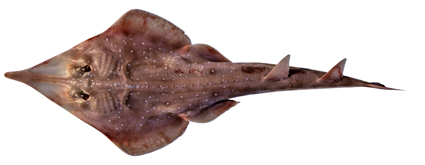
Spotted Shovelnose Ray
VU

Spotted Shovelnose Ray

Aptychotrema timorensis

Unknown

Photo: Wikimedia Commons (CC) via https://en.wikipedia.org/wiki/Spotted_shovelnose_ray

Overview

Aptychotrema timorensis is a species of ray characterized by a flattened, guitar-shaped body, an elongated snout, and dorsally positioned eyes, features typical of shovelnose rays adapted to a benthic lifestyle. Its body is patterned with distinct spots, giving rise to its common name. As a bottom-dwelling predator, it forages along the seafloor for small invertebrates and fish, using its sensory-rich snout to detect prey buried in sediment.

Like other rhinopristiform rays, it plays a role in benthic ecosystems as a mid-level predator, helping regulate invertebrate populations.

This species inhabits marine waters, typically over sandy or muddy substrates on continental shelves. Its known range includes waters off Australia, with additional records reported from Taiwan, though its overall distribution appears patchy and restricted compared to related species.

The primary threat to this ray is incidental capture in commercial and recreational fishing operations, including trawl and net fisheries that operate across its shelf habitat. As a bottom-dwelling species with limited mobility and a restricted range, it is particularly vulnerable to bycatch mortality. Additional unspecified pressures, categorized broadly as other ongoing threats, may compound the impact of fishing activity, though these are not well documented.

Targeted conservation measures specific to this species remain limited. Broader fisheries management frameworks in Australian waters, including bycatch reduction devices and spatial fishing restrictions, may offer incidental protection, though enforcement and applicability to this species specifically are not well established.

Given its restricted range, ongoing exposure to fishing pressure, and the absence of dedicated monitoring, the species' population trend remains unknown. Without targeted data collection and management action, its conservation status is unlikely to improve in the near term.

The Spotted Shovelnose Ray is mainly threatened by ongoing fishing activity, where it is likely caught unintentionally in nets and other gear used to harvest fish and other sea life. There are also additional, unspecified pressures affecting the species that are not clearly detailed in current records. Based on the available information, these threats appear to be continuing steadily rather than clearly increasing or decreasing.

Threat summary

Habitat

MARINE· major

Conservation measures underway

Species recovery

Frequently asked questions

Why is Spotted Shovelnose Ray classified as Vulnerable?
Spotted Shovelnose Ray is classified as Vulnerable because the population is declining and the species faces a high risk of extinction in the medium-term future if current pressures continue. The Spotted Shovelnose Ray is mainly threatened by ongoing fishing activity, where it is likely caught unintentionally in nets and other gear used to harvest fish and other sea life. There are also additional, unspecified pressures affecting the species that are not clearly detailed in current records. Based on the available information, these threats appear to be continuing steadily rather than clearly increasing or decreasing.
Where does Spotted Shovelnose Ray live?
Spotted Shovelnose Ray occurs in Australia, and Taiwan. Country-level distribution data is sourced from the IUCN Red List and cross-referenced with GBIF occurrences.
What are the main threats to Spotted Shovelnose Ray?
The main threats to Spotted Shovelnose Ray are 12.1, and 5.4. The full IUCN-classified threat record for this species is detailed on the species page.

Get weekly conservation intelligence

One short digest a week of the most striking species and country data we ship, plus breaking conservation news paired with our database where it matters.

Free, no spam. One-click unsubscribe in every email.