Anthrax trifasciatus
Overview
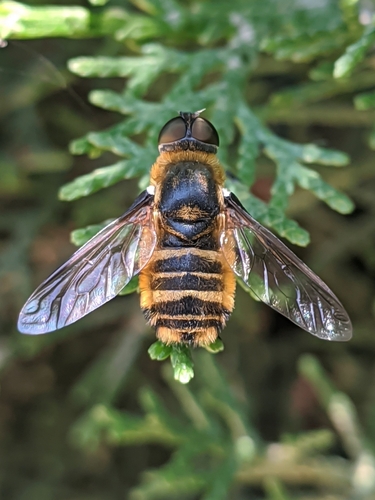
Anthrax trifasciatus is a bee fly, a member of the family Bombyliidae within the order Diptera. Like other bee flies, it is a robust, often densely haired fly that mimics bees or wasps in appearance and flight behavior, typically featuring patterned wings and a compact, bristled body. Adults are usually observed hovering near the ground or basking on bare sand in sunny conditions, feeding on nectar and pollen from low-growing flowers.
Its larvae are parasitoids, developing within the nests or bodies of other insects, a life history that links this species to broader insect community dynamics and positions it as a natural regulator of host populations.
The species has a wide but patchy distribution across Europe, North Africa, western Asia, and Australia, with records spanning countries from Scandinavia to the Mediterranean and North Africa, as well as Oman. It is closely associated with sandy substrates, including coastal dunes and other open, sparsely vegetated sandy habitats where its larval hosts are found.
Anthrax trifasciatus is classified as Vulnerable, primarily due to ongoing habitat loss from agricultural expansion and coastal urban development, both of which degrade the sandy environments it depends on. Recreational activity in dune systems causes further physical disturbance, while disruption of host insect populations threatens its reproductive success. Climate-related changes to sandy habitat conditions add additional pressure.
Specific conservation programs targeting this species are not well documented, though it may benefit indirectly from dune and coastal habitat protection measures in parts of its range. Population trends remain unknown, and without targeted monitoring or habitat safeguards, the cumulative and ongoing nature of these threats suggests continued vulnerability for this species.
This species is losing its sandy coastal habitat as land gets converted for farming and built up with housing and other development, while people visiting dunes for recreation also disturb these fragile areas. Because this insect depends on specific host species to complete its life cycle, declines in those hosts pose an additional risk, and shifting climate patterns are further altering the sandy conditions it needs to survive. All of these pressures are currently ongoing, suggesting the overall threat level is stable to worsening rather than improving.
Habitat
This specialized bee fly inhabits open sandy environments including coastal dunes, sandy heathlands, and inland sandy clearings. It requires areas with sparse vegetation where its host insects, typically ground-nesting bees and wasps, maintain active populations in the sandy substrate.
Other threatened species in Bombyliidae
Threatened in Algeria


Frequently asked questions
Why is Anthrax trifasciatus classified as Vulnerable?
Where does Anthrax trifasciatus live?
What are the main threats to Anthrax trifasciatus?
Get weekly conservation intelligence
One short digest a week of the most striking species and country data we ship, plus breaking conservation news paired with our database where it matters.
Free, no spam. One-click unsubscribe in every email.