Scalloped Hammerhead
Sphyrna lewini
Overview
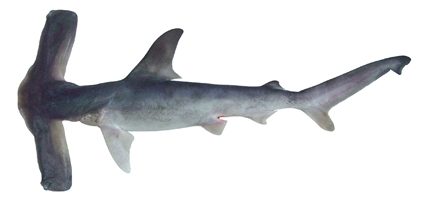
Sphyrna lewini is a large migratory shark distinguished by its laterally extended, hammer-shaped head, or cephalofoil, which enhances sensory detection and maneuverability while hunting. Individuals can exceed 3 meters in length and are known for forming large daytime schools around seamounts and islands before dispersing to hunt solitarily at night on fish, cephalopods, and crustaceans. As an apex and mesopredator, the species helps regulate prey populations and maintain balance within reef and pelagic food webs.
The species has a circumglobal distribution in warm temperate and tropical waters, occupying coastal, intertidal, and oceanic habitats. It is recorded across a vast range of countries spanning the Indo-Pacific, Atlantic, and eastern Pacific, including Indonesia, Mexico, Brazil, Mozambique, and the United States, often using coastal nurseries before moving into deeper offshore waters as adults.
This species is classified as Critically Endangered, with a decreasing population trend. Its low reproductive rate and tendency to aggregate make it highly vulnerable to targeted fishing for the shark fin trade, as well as bycatch in commercial longline and gillnet fisheries. Illegal, unreported, and unregulated fishing compounds these pressures, while coastal habitat degradation, pollution, and shifting prey distributions linked to climate change further threaten nursery grounds and food availability.
Conservation efforts include international trade regulation under CITES Appendix II, regional fishing and finning bans, marine protected areas covering key aggregation sites, and ongoing satellite tagging and population monitoring studies. Enforcement remains inconsistent across much of its range. Given continued fishing pressure and slow recovery potential, the species' outlook remains poor without substantial reductions in mortality across both targeted and incidental catch.
Scalloped Hammerhead sharks are primarily threatened by hunting for their fins, which are used in the shark fin trade, as well as accidentally getting caught in longline and gillnet fishing gear meant for other species. Additional pressures include pollution and damage to the coastal areas where they live, along with climate change altering the availability of their prey, and illegal fishing that goes undetected or unpunished. These threats show no signs of slowing down and are considered ongoing and intensifying.
Habitat
Scalloped hammerheads inhabit tropical and warm temperate coastal waters, typically found from the surface to depths of 450 meters around continental shelves, islands, and seamounts. Juveniles prefer shallow coastal nursery areas including mangroves and estuaries, while adults form large aggregations around seamounts and offshore islands.
Conservation measures underway
Other threatened species in SPHYRNIDAE

Threatened in Angola



Frequently asked questions
Why is Scalloped Hammerhead classified as Critically Endangered?
Where does Scalloped Hammerhead live?
What are the main threats to Scalloped Hammerhead?
Get weekly conservation intelligence
One short digest a week of the most striking species and country data we ship, plus breaking conservation news paired with our database where it matters.
Free, no spam. One-click unsubscribe in every email.