
Great Hammerhead
Sphyrna mokarran
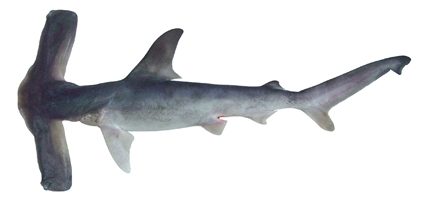
Photo: Photo: Wikimedia Commons, CC BY-SA
Overview
Sphyrna mokarran is the largest of the hammerhead sharks, distinguished by a wide, straight-edged cephalofoil (the "hammer") and a tall, curved first dorsal fin. Individuals can exceed 5 meters in length. This apex predator feeds heavily on stingrays and other benthic fish, cephalopods, and crustaceans, using its head shape to pin down prey against the seafloor.
As a top predator, it plays an important role in regulating populations of mesopredators and maintaining balance in marine food webs.
The species inhabits tropical and warm temperate coastal and pelagic waters worldwide, ranging over continental shelves, lagoons, and reef systems. It has been recorded in the waters of dozens of nations across the Atlantic, Indian, and Pacific Oceans, including Australia, Brazil, the United States, Mozambique, Indonesia, and the Bahamas, among many others.
Great hammerheads face severe pressure from targeted commercial fishing and shark finning, driven by high value fins in international trade. They are also frequently caught as bycatch in longline and gillnet fisheries, and their large dorsal fin makes them especially prone to finning even when not the primary target. Coastal habitat degradation reduces nursery and foraging areas, while shifts in prey distribution linked to climate change add further stress.
The species' slow growth, late maturity, and low reproductive output severely limit its capacity to recover from these losses.
Conservation measures include international trade restrictions under CITES Appendix II, regional fishing regulations, and shark sanctuaries in select nations. Enforcement remains inconsistent across much of its range. Population trends continue to decline, and without stronger, coordinated international protections, the species remains at high risk of further decline toward extinction.
Great hammerhead sharks are mainly threatened by fishing: they're caught on purpose for their valuable fins and meat, and also get accidentally trapped in longlines and gillnets set for other fish. These sharks reproduce slowly, so their populations can't bounce back quickly from these losses, and this problem is made worse by coastal habitats being damaged and by climate change shifting the fish they rely on for food. Overall, these threats appear to be ongoing and intensifying rather than easing.
Habitat
Great Hammerhead Sharks inhabit tropical and warm temperate coastal waters worldwide, typically found in continental and insular shelves from the surface to depths of 80 meters. They frequent coral reefs, lagoons, and nearshore areas, often moving into shallow waters including mangrove areas and estuaries, particularly during pupping season.
Conservation measures underway
Other threatened species in SPHYRNIDAE

Threatened in Australia
Frequently asked questions
Why is Great Hammerhead classified as Critically Endangered?
Where does Great Hammerhead live?
What are the main threats to Great Hammerhead?
Get weekly conservation intelligence
One short digest a week of the most striking species and country data we ship, plus breaking conservation news paired with our database where it matters.
Free, no spam. One-click unsubscribe in every email.