
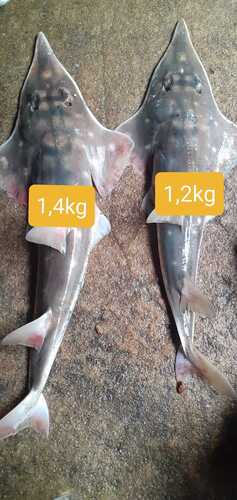
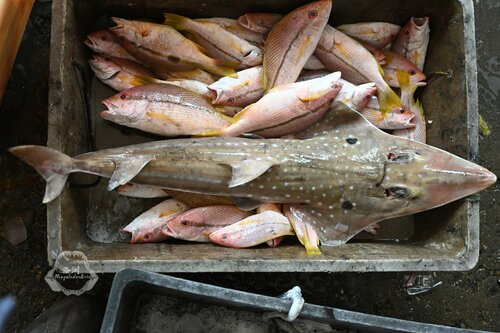
Bowmouth Guitarfish
Rhina ancylostomus
Photo: Photo: Wikimedia Commons, CC BY-SA
Overview
The bowmouth guitarfish is a large, distinctive cartilaginous fish recognizable by its wide, rounded snout, shark-like body, and ray-like flattened pectoral fins, along with prominent ridges above the eyes and a boldly patterned juvenile coloration that fades with age. It can grow to notable size and is a benthic predator, feeding on crustaceans, molluscs, and small bony fishes, using crushing tooth plates to process hard-shelled prey. As a mid-to-upper trophic level predator, it plays a role in structuring benthic invertebrate communities on the reef and soft-bottom habitats it frequents.
The species occurs across the Indo-West Pacific, with recorded range including Australia, Japan, New Caledonia, and South Africa. It typically inhabits shallow coastal waters, estuaries, and reef-associated sandy or muddy substrates, though comprehensive habitat assessments remain lacking.
Its population is declining sharply due to intense fishing pressure across its range. It is heavily targeted for its large, valuable fins, which are prized in the shark fin trade, and it is also taken as bycatch in trawl and gillnet fisheries. Coastal habitat degradation, land-based development, and ecosystem modification further reduce nursery and foraging grounds.
Its slow reproductive rate limits population recovery even where fishing pressure is reduced, making it highly vulnerable to sustained exploitation.
Conservation measures include international trade regulations affecting shark and ray fin products, along with some regional fishing restrictions and marine protected areas that offer partial refuge. Enforcement and monitoring remain inconsistent across much of its range.
Given ongoing bycatch, targeted harvest, and habitat loss, combined with the species' limited reproductive capacity, the bowmouth guitarfish's population trajectory remains negative, and it is currently classified as Critically Endangered.
The Bowmouth Guitarfish is caught both on purpose and accidentally as bycatch in nets and trawl fishing gear, with its fins especially prized for the fin trade, while the destruction of coastal habitats like mangroves and nearshore waters—often due to coastal development and logging—removes places where it lives and breeds. Because this species reproduces slowly, populations struggle to bounce back once numbers drop from fishing pressure. These combined threats appear to be ongoing and intensifying, driven largely by continued demand for its fins and steady loss of coastal habitat.
Habitat
Rhina ancylostomus inhabits shallow coastal waters, estuaries, and sandy or muddy bottoms from the intertidal zone to depths of approximately 90 meters. The species relies on mangrove areas and seagrass beds as critical nursery habitats for juveniles.
Conservation measures underway
Other threatened species in RHINIDAE

Threatened in Australia
Frequently asked questions
Why is Bowmouth Guitarfish classified as Critically Endangered?
Where does Bowmouth Guitarfish live?
What are the main threats to Bowmouth Guitarfish?
Get weekly conservation intelligence
One short digest a week of the most striking species and country data we ship, plus breaking conservation news paired with our database where it matters.
Free, no spam. One-click unsubscribe in every email.