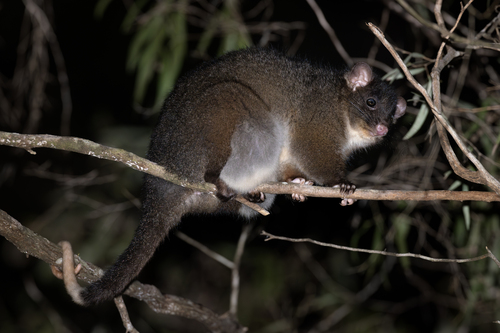
Western Ringtail Possum
Pseudocheirus occidentalis
Photo: (c) Chris Burney, all rights reserved, uploaded by Chris Burney
Overview
Pseudocheirus occidentalis is a small, nocturnal arboreal marsupial with dense grey-brown fur, a pale underside, and a long prehensile tail used for gripping branches while climbing. It feeds almost exclusively on eucalypt and peppermint tree leaves, playing a role in nutrient cycling and seed dispersal within its forest habitat, and constructs nests known as dreys from shredded bark and twigs. Highly folivorous and sensitive to heat stress, it relies on continuous forest canopy for both food and thermal shelter.
The species is endemic to the south-west corner of Western Australia, occupying peppermint (Agonis flexuosa) woodlands, jarrah and marri forests, coastal shrubland, and increasingly fragmented urban and semi-urban vegetation patches near towns such as Busselton and Mandurah.
Its decline stems from clearing of native vegetation for housing, agriculture, and commercial development, combined with logging of forest habitat. Predation by introduced foxes and cats has severely reduced populations, particularly where tree cover is sparse and animals must cross open ground. Increasing drought frequency, heat extremes linked to climate change, and altered fire regimes have caused direct mortality and degraded remaining habitat, while fire suppression practices have altered forest structure in ways that affect food availability.
Conservation responses include habitat protection and revegetation programs, predator control initiatives targeting foxes and cats, translocation and captive breeding efforts, and monitoring of wild populations to track distribution and abundance. Urban planning guidelines in parts of its range now incorporate provisions for retaining possum habitat corridors.
Despite these measures, the population continues to decline, and the species remains classified as Critically Endangered. Ongoing habitat loss, predation pressure, and climate-related stress suggest continued vulnerability unless threat mitigation is substantially expanded and sustained.
The Western Ringtail Possum is losing its home as native forests are cleared for housing, farming, and logging, and the bush that remains is increasingly damaged by fires and prolonged droughts linked to a changing climate. It also faces constant danger from introduced predators like foxes and cats, which hunt it directly. These combined pressures on both habitat and survival appear to be ongoing and intensifying rather than easing.
Habitat
The Western Ringtail Possum inhabits coastal peppermint (Agonis flexuosa) woodlands and shrublands in southwestern Western Australia, particularly favoring areas with dense canopy cover. They also utilize adjacent eucalyptus woodlands and mallee scrublands, requiring continuous tree cover for movement and nesting in tree hollows.
Conservation measures underway
Other threatened species in PSEUDOCHEIRIDAE

Threatened in Australia
Frequently asked questions
Why is Western Ringtail Possum classified as Critically Endangered?
Where does Western Ringtail Possum live?
What are the main threats to Western Ringtail Possum?
Get weekly conservation intelligence
One short digest a week of the most striking species and country data we ship, plus breaking conservation news paired with our database where it matters.
Free, no spam. One-click unsubscribe in every email.